
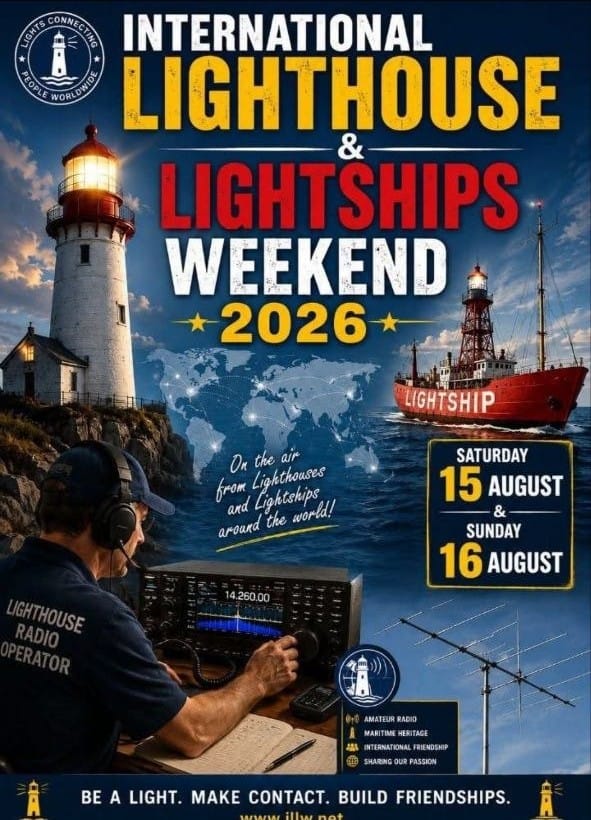
On Saturday 15 August and Sunday 16 August 2026, amateur radio operators around the world will take part in the International Lighthouse and Lightship Weekend, a global on-air event that celebrates the historic relationship between radio, lighthouses, lightships and maritime safety. The 2026 event runs from 00:01 UTC on 15 August to 24:00 UTC on 16 August, and is part of a long-running international amateur radio tradition.
At first glance, lighthouses, lightships and amateur radio appear to belong to different worlds. Lighthouses are fixed, visible and coastal. They stand on headlands, islands, harbour approaches and dangerous shorelines, guiding mariners away from rocks, reefs and sandbanks. Lightships served a similar purpose in places where it was not practical to build a lighthouse. Radio, by contrast, is invisible. It travels through the air, crosses borders, bridges distance and allows people to communicate beyond the horizon.
Yet lighthouses, lightships and radio all share the same purpose: to guide, to warn, to connect and to protect. A lighthouse sends out a beam of light to help sailors find their way. A radio signal carries a voice, a call sign, a message or a distress call across distance. Both are about safety. Both are about reassurance. Both say, in different ways, that someone is there.
The International Lighthouse and Lightship Weekend brings these ideas together. Amateur radio stations are established at, near, or in support of lighthouse and lightship locations, and operators make contact with other stations around the world. The event normally takes place on the third full weekend in August each year and attracts hundreds of lighthouse entries from many countries. It is not simply a contest. It is a celebration of maritime heritage, international friendship, radio communication and public awareness.
For amateur radio operators, the event is a wonderful opportunity to combine technical skill with history and public engagement. Operators may use voice, Morse code, digital modes or VHF and HF equipment, depending on the station and conditions. Some will operate from lighthouse sites. Others will work from clubs, homes or portable locations, making contact with lighthouse stations and helping to keep the event active on the bands.
A Landlocked County Taking Part in a Maritime Event
There is also an interesting local angle for County Kildare. Kildare is a landlocked county. It has no coastline, no sea cliffs, no harbour lighthouse and no historic lightship station of its own. On the surface, that might make it seem distant from the world of lighthouses and lightships.
But that is exactly where amateur radio changes the story.
Radio is not limited by geography. An operator in Kildare does not need to stand beside the sea to take part in Lighthouse and Lightship Weekend. From an inland station in Naas, Newbridge, Clane, Maynooth, Athy, Kilcullen or anywhere else in the county, a Kildare radio amateur can make contact with lighthouse and lightship stations across Ireland, Britain, Europe and beyond. In that sense, Kildare may be landlocked, but it is certainly not disconnected.
Kildare also has its own relationship with navigation and water. The Grand Canal and the Barrow Line pass through the county and historically linked inland Ireland with wider commercial and transport routes. Waterways Ireland notes that the Barrow Line links the Grand Canal with the River Barrow at Athy and passes through Kildare countryside. The history of the Grand Canal also records the development of passenger and trade routes through places such as Sallins, Robertstown and Monasterevin.
This gives Kildare a different but still meaningful place in the story. Coastal lighthouses guided ships at sea. Inland waterways guided boats, trade and communities through the interior. Both were part of the broader history of navigation, movement and connection. The lighthouse marked the danger of the coast; the canal lock, towpath and bridge shaped safe passage inland.
There is also a modern maritime-service connection. North Kildare RNLI volunteers raised €117,000 to fund a new D class inshore lifeboat for Wexford RNLI, with the lifeboat to be named Cill Dara in recognition of the inland branch’s contribution to saving lives at sea. That is a powerful reminder that a landlocked county can still contribute meaningfully to maritime safety.
Kildare Operators on the Air
For Kildare amateur radio operators, participation on 15 and 16 August 2026 is therefore both symbolic and practical. While Kildare does not have a lighthouse to activate, its operators can still support the event by calling lighthouse and lightship stations, logging contacts, promoting the activity locally and helping to keep the bands active over the weekend.
There is something particularly fitting about an inland county taking part. The theme of the weekend is connection. A lighthouse connects sea to land. A lightship connects a dangerous offshore location to safe navigation. Amateur radio connects people across distance. So when a Kildare station makes contact with a lighthouse station, it is helping to extend the reach of that maritime story inland.
The participation of Kildare operators also helps demonstrate one of the great strengths of amateur radio: it allows people to take part in international events from almost anywhere. A modest station, a simple antenna, good operating practice and a little patience can connect Kildare with coastal stations across the world. Each contact becomes a small act of remembrance and friendship.
Keeping the Light Alive
The phrase often associated with Lighthouse and Lightship Weekend is simple but powerful: “Be a light. Make contact. Build friendships.” That message captures the spirit of the event. It is about more than radio signals. It is about heritage, public service, curiosity, community and international goodwill.
For those operating from Kildare, the message is especially appropriate. We may not have a lighthouse on our horizon, but we can still help carry the light. We can listen for lighthouse stations. We can call CQ. We can explain the event to visitors, friends and family. We can remind people that radio still matters, not only as a hobby, but as a resilient and fascinating form of communication.
On 15 and 16 August 2026, amateur radio operators in Kildare will join others around the world in celebrating the long relationship between lighthouses, lightships and radio. From a landlocked county, they will reach out to the coast, to the sea and to the wider amateur radio community. And in doing so, they will prove that you do not need to live beside a lighthouse to help keep its story alive.