

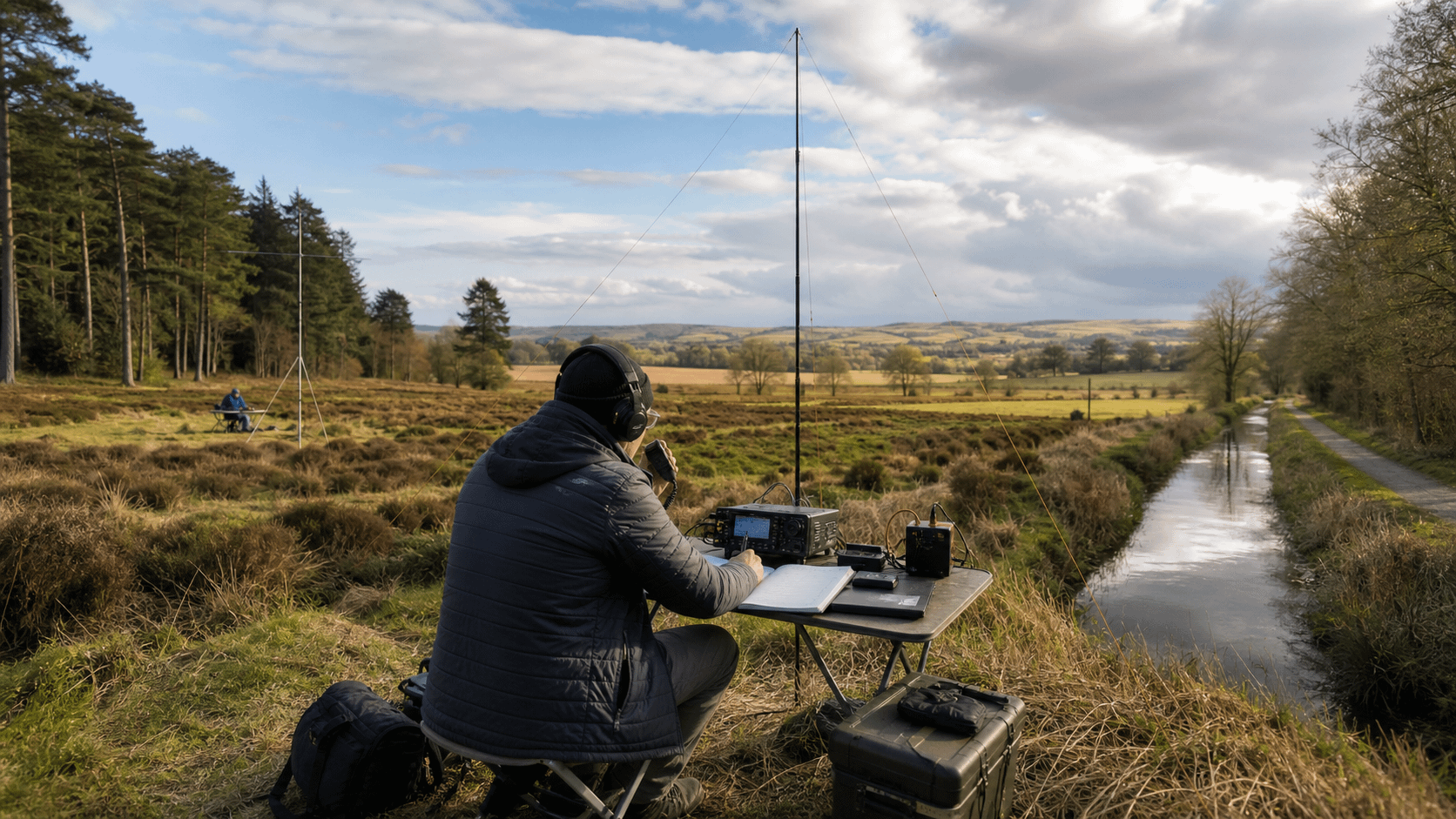
Amateur radio becomes especially enjoyable when it gets us out of the shack and into the real world. Parks on the Air, better known as POTA, is one of the best ways to do that. It combines portable radio, outdoor activity, antennas, batteries, logging, local exploration and the challenge of making contacts from recognised park locations.
For members of Kildare Amateur Radio Club, POTA is a natural fit. County Kildare has open plains, forest parks, canals, bogland, heritage sites and several recognised POTA locations within easy reach. It gives local operators a reason to get outdoors, test portable equipment, promote the hobby and put Kildare on the air.
What Is POTA?
POTA is an international amateur radio activity that encourages operators to make contacts from designated parks and protected public lands. The official Parks on the Air website describes POTA as supporting international portable amateur radio operations that promote emergency awareness and communications from recognised park areas.
There are two main roles in POTA.
An activator travels to a recognised POTA park, sets up a temporary radio station and makes contacts from within the park boundary.
A hunter contacts activators from home, mobile, portable or from another park.
Both roles are important. In fact, the easiest way to begin is usually as a hunter. You can listen for POTA stations, make a few contacts and learn the style of operation before attempting your first activation.
Why POTA Appeals to Radio Amateurs
POTA is popular because it gives amateur radio a clear purpose. Instead of simply turning on the radio and hoping to find activity, you have a mission: go to a park, set up a station, make contacts and upload your log.
It appeals to operators who enjoy:
Portable radio.
Simple antennas.
Battery operation.
HF operating.
VHF and UHF experiments.
Outdoor activity.
Awards and logging.
Emergency-style field communication.
Club field days.
Local exploration.
It is also very flexible. A POTA activation can be a quick one-hour session from a picnic table or a more organised club outing with multiple operators and antennas.
What Counts as a Successful Activation?
Under POTA rules, a successful activation normally requires at least 10 QSOs from a valid park during a single UTC day. The POTA rules explain that activators must operate from a park on the designated list and make the required number of contacts within one Zulu day.
Even if you make fewer than 10 contacts, it is still good practice to submit your log because the hunters who contacted you may still receive credit.
A Kildare Perspective
Kildare is an excellent county for POTA-style activity because it has a mixture of open, accessible and historically interesting landscapes. Some locations offer space for HF antennas, while others are better suited to compact VHF/UHF operation or short portable sessions.
Before heading out, always check the current POTA map or app, as park references and boundaries can change. POTA’s own app provides the park list and map for finding valid entities.
The following Kildare-area locations are good starting points to explore.
Curragh Plains Conservation Area — IE-0212
The Curragh Plains is one of the most distinctive open landscapes in County Kildare. POTA listings identify it as IE-0212 Curragh Plains, and recent POTA alert listings also show activity from IE-0212 Curragh Plains Conservation Area.
From a radio perspective, the Curragh has several advantages. It is open, relatively uncluttered and well suited to temporary portable operating. For HF, the openness may make it easier to deploy a simple wire antenna, provided it is done safely and without obstructing anyone. For VHF/UHF, the open ground may also be useful for testing portable antennas and handheld performance.
However, the Curragh is a shared and sensitive landscape. Operators should be careful not to interfere with walkers, livestock, horse activity, vehicles or military-related areas. Keep the station compact, visible and temporary.
Best suited to: HF portable, VHF/UHF testing, short activations, beginner demonstrations.
Watch out for: public access, livestock, weather exposure, safe antenna layout and avoiding any obstruction.
Donadea Park — IE-0127
Donadea Forest Park is a very attractive option for a Kildare-area POTA outing. POTA alert listings show activity from IE-0127 Donadea Park Park. Discover Ireland describes Donadea Forest Park as a National Heritage Area of mixed woodland in northwest County Kildare, with walking routes, historic features and gardens.
Donadea is likely to suit a relaxed club-style activation rather than a large technical experiment. Woodland can affect some signals, but it is a comfortable and scenic location for portable radio. It also gives beginners a chance to see a compact station in operation without needing to climb a hill or carry heavy equipment.
A small HF station with a carefully placed vertical or wire antenna may work well, but avoid running wires across tracks or busy walking areas. A VHF/UHF station with a compact vertical can also be useful.
Best suited to: club outings, beginner POTA demonstrations, compact HF or VHF setups, portable listening.
Watch out for: car park arrangements, visitor numbers, trees, walking paths and antenna safety.
Moore Abbey Woods National Forest — IE-0128
Moore Abbey Woods near Monasterevin is another Kildare-area POTA option. Amateur radio locator listings identify IE-0128 Moore Abbey Woods National Forest as a POTA reference, and other POTA-related listings also associate Moore Abbey Woods with IE-0128.
This location has strong potential for a local activation because it combines woodland, heritage, and accessibility from the Kildare/Monasterevin area. It may be particularly suitable for a lightweight activation using a small radio, battery and compact antenna.
As with any woodland site, avoid attaching wires or supports in a way that could damage trees or create hazards. Keep equipment close, stay on permitted routes and avoid blocking paths.
Best suited to: lightweight POTA, QRP operating, club training, portable antenna practice.
Watch out for: boundaries, paths, visitor access and safe deployment of wires.
Bog of Allen and Lullymore Area
The Bog of Allen is one of the great landscape features of the Midlands and includes areas of Kildare around Rathangan, Lullymore and surrounding peatland. The Bog of Allen Nature Centre is in Lullymore near Rathangan and is run by the Irish Peatland Conservation Council as a centre for peatland education, conservation and research.
For a Kildare POTA-themed outing, bogland and peatland areas are interesting because they link radio activity with local natural heritage. Open landscapes may provide useful horizons for portable operation, but conservation sensitivity is very important.
Operators should only use permitted access points, stay on paths, avoid damaging habitats, and check whether the specific area is included in the current POTA list before planning an activation.
Best suited to: educational club outings, low-impact portable sessions, listening, nature-and-radio themed activities.
Watch out for: conservation rules, wet ground, access restrictions and avoiding habitat disturbance.
Canal-Side Locations in Kildare
The Grand Canal and Royal Canal corridors are important recreational features in Kildare. Kildare County Council identifies the Grand and Royal canals among the county’s open-space and recreational amenities.
Canal-side locations may not always be POTA references themselves, but they can be useful for portable practice, radio walks, or pre-activation testing. They are also good locations for practising compact setups before visiting a recognised POTA site.
A handheld, small mobile radio, roll-up antenna or receive-only SDR setup can work well along a canal. Avoid long wires across towpaths and keep equipment well clear of walkers, cyclists, anglers and boats.
Best suited to: portable practice, radio walks, VHF/UHF, receive-only listening, compact setups.
Watch out for: towpath users, trip hazards, water safety and whether the location is actually within a POTA boundary.
Local Parks and Community Spaces
Kildare County Council manages 19 parks across the county, ranging from small local parks to larger open spaces with walks, pitches, playgrounds, seating and picnic areas.
Not all local parks will qualify for POTA. POTA generally depends on recognised park entities listed in the POTA system. However, local parks are excellent places to practise portable operation, test antennas, train new members and prepare for a proper activation.
For a club, a local park or community space can be a good first step before organising an activation at a recognised POTA reference.
Best suited to: beginner practice, antenna testing, club demonstrations, radio familiarisation.
Watch out for: permissions, public safety, children’s areas, trip hazards and local rules.
Suggested First Kildare POTA Setup
For a first Kildare activation, keep the station simple.
A practical HF setup might include:
HF transceiver.
Battery pack.
End-fed wire, linked dipole or compact vertical.
Lightweight mast or support.
Coax cable.
Antenna tuner if needed.
Headphones.
Paper logbook.
Phone for spotting if coverage is available.
Weatherproof bag.
For VHF/UHF, bring:
Handheld or mobile radio.
Spare battery.
Better whip or roll-up antenna.
Small mast if appropriate.
Notebook.
Local repeater and simplex frequency information.
The aim is not to bring every piece of equipment you own. The aim is to bring a station you can carry, set up safely and operate confidently.
How a Kildare ARC POTA Day Could Work
A club POTA outing could be simple and effective.
Choose a suitable POTA reference, such as Curragh Plains, Donadea Park or Moore Abbey Woods.
Confirm the current reference and boundaries on the POTA map.
Check access, parking and weather.
Agree a meeting time and operating plan.
Bring one or two simple stations rather than too much equipment.
Set up safely and away from public paths.
Spot the activation on POTA.
Invite members to operate or log.
Take photos for the club website.
Upload the log afterwards.
Write a short activation report.
This kind of event is ideal for beginners because they can see the whole process from planning to logging.
Good Operating Practice for POTA
POTA contacts are usually short and efficient. The activator calls CQ, hunters respond, signal reports are exchanged and both stations log the contact.
A typical call might be:
“CQ Parks on the Air, this is EI___ portable.”
During busy periods, keep exchanges brief. Give your call sign clearly, acknowledge stations accurately and avoid long overs if a queue of hunters is waiting.
Good practice includes:
Listen before transmitting.
Ask if the frequency is in use.
Use clear call signs.
Respect band plans.
Keep a clean log.
Be patient with weak stations.
Avoid causing interference.
Be polite to park users.
Leave no trace.
Safety and Access
Safety is central to any portable radio activity.
Never set up near overhead power lines.
Do not run wires across public paths.
Keep guy ropes visible.
Avoid operating in thunderstorms.
Secure masts properly.
Keep batteries protected.
Do not block gates, tracks or car parks.
Respect park rules.
Take all litter home.
Do not damage trees, fences or habitats.
A good POTA activation should be almost invisible after you leave.
Why POTA Is Good for Kildare Amateur Radio Club
POTA gives Kildare ARC a practical and visible way to promote amateur radio. It supports many of the club’s core interests: portable operating, antenna experimentation, training, emergency preparedness, public engagement and local activity.
It also allows the club to tell a Kildare story. Activations from the Curragh, Donadea, Moore Abbey or bogland areas can link amateur radio with local landscapes and heritage.
For new members, POTA is a friendly way to learn. For experienced members, it provides a fresh challenge. For the public, it shows that amateur radio is active, practical and relevant.
Final Thoughts
Parks on the Air is one of the most accessible and enjoyable parts of modern amateur radio. It does not require a large station or expensive equipment. A simple radio, battery, antenna and logbook can be enough to get started.
From a Kildare perspective, POTA offers excellent possibilities. The Curragh Plains, Donadea Park, Moore Abbey Woods and the wider Bog of Allen/Lullymore area all provide strong themes for portable radio activity, local exploration and club engagement.
Start by hunting a few POTA activators from home. Then join a club outing or try a simple activation yourself. Keep it safe, keep it simple and enjoy putting Kildare on the air.
Hi my name is Peter EI2JIB POTA and Bunkers is a great way to activite the airwaves, out in the open environment fresh air and peace and quite, also away from the towns and big cities with Less noise to contend with, all ham operators should do this as its good for your mental health to get away from your daily routine and watch the world pass bye for a few hours.