

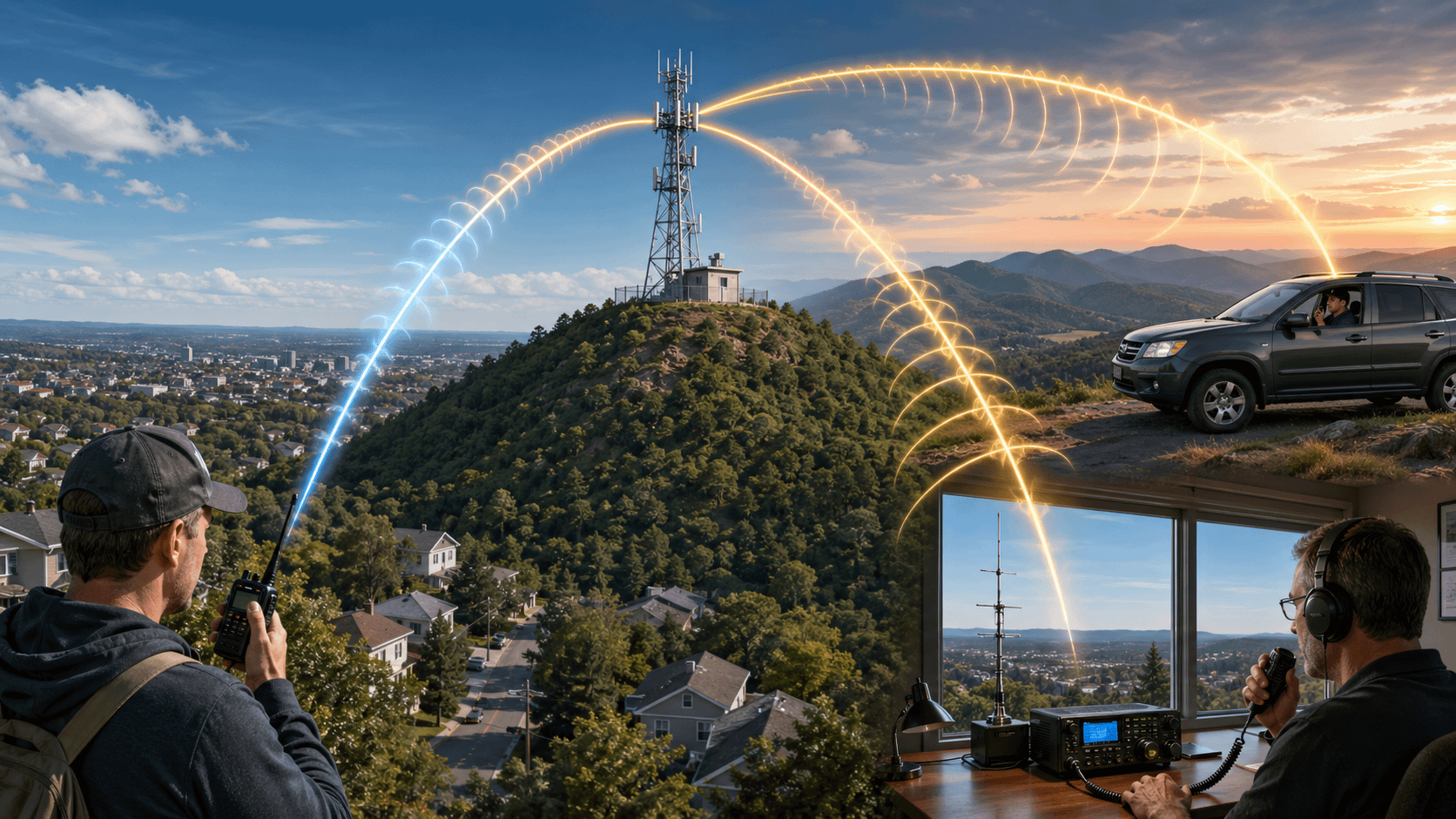
If you are new to amateur radio, one of the first terms you will hear is repeater. Repeaters are an important part of VHF and UHF radio communication, especially for local and regional contacts. They allow radio amateurs using handheld or mobile radios to communicate over much greater distances than they could by direct radio-to-radio communication alone.
For many beginners, making a first contact through a repeater is one of the easiest and most enjoyable ways to get started on air.
What Is a Repeater?
A repeater is a radio station, usually located on a high site, that receives a signal on one frequency and retransmits it on another frequency at the same time.
In simple terms, you transmit to the repeater, and the repeater rebroadcasts your signal over a wider area.
This is useful because handheld and mobile radios are often limited by buildings, hills, trees and the curvature of the earth. If the repeater is located on a hill, tower, mast or tall building, it can “hear” signals from a wide area and transmit them back out over a much larger coverage zone.
A repeater acts like a helpful relay station. It does not create the conversation itself; it simply extends the range of the operators using it.
Why Are Repeaters Useful?
Repeaters are useful because they make local and regional communication easier. A small handheld radio may only reach a few kilometres directly, especially in a built-up area or from inside a house. But if that handheld can reach a repeater, the signal may be heard across a much larger area.
Repeaters are commonly used for:
- Local conversations between radio amateurs
- Club nets and scheduled contacts
- Mobile communication while travelling
- Calling for local operators
- Emergency and backup communication exercises
- Public service and community event support
- Helping beginners get on the air
For new operators, repeaters are particularly helpful because they often have regular users and scheduled nets. This gives beginners a place to listen, learn and eventually make contacts.
Direct Communication Versus Repeater Communication
When two radios communicate directly with each other, this is called simplex operation. Both stations use the same frequency to transmit and receive.
Repeater operation is different. Your radio transmits on one frequency and listens on another. The repeater receives your signal on its input frequency and retransmits it on its output frequency.
Most operators talk about the repeater’s output frequency because that is the frequency you listen to. Your radio then automatically shifts to the correct input frequency when you press the transmit button, provided it has been programmed correctly.
The Basic Parts of a Repeater Setup
To use a repeater, your radio usually needs four key pieces of information:
- Receive frequency
This is the repeater output frequency. It is the frequency you listen to. - Transmit offset
This is the difference between the frequency you listen on and the frequency your radio transmits on. - Shift direction
The transmit frequency may be above or below the receive frequency. This is usually shown as a plus or minus shift. - Access tone
Many repeaters require a tone, often called CTCSS, to access the repeater. This helps prevent the repeater from being triggered by unwanted signals or interference.
Once these details are programmed into your radio, using the repeater becomes much easier.
What Is an Offset?
An offset is the difference between the repeater’s transmit and receive frequencies.
For example, you might listen to a repeater on one frequency, but when you press transmit, your radio automatically transmits slightly higher or lower. The repeater listens on that input frequency and then retransmits your audio on the output frequency.
You do not usually need to calculate this manually every time. Most radios allow you to store the repeater details in a memory channel, including the frequency, offset and tone.
What Is CTCSS?
CTCSS stands for Continuous Tone-Coded Squelch System. It is a low-frequency tone transmitted along with your voice signal. You normally do not hear the tone, but the repeater detects it.
If the correct tone is present, the repeater opens and retransmits your signal. If the tone is missing or incorrect, the repeater may ignore your transmission.
Beginners sometimes think their radio is faulty when they can hear a repeater but cannot access it. Very often, the issue is simply that the correct tone, offset or shift has not been programmed.
How Do You Know If You Can Reach a Repeater?
The first step is to listen. Tune to the repeater’s output frequency and wait. You may hear conversations, call signs, identification tones or scheduled nets.
If you are licensed and your radio is correctly programmed, you can make a short test call. Keep it brief and clear. For example:
“This is EI___ testing through the repeater. Can anyone give me a signal report?”
Use your own call sign and follow licence conditions. If someone replies, they may tell you how well you are getting into the repeater.
If nobody replies, that does not always mean you are not reaching the repeater. It may simply mean nobody is listening at that moment.
How to Make a Call Through a Repeater
Repeater contacts should be clear, polite and not too long, especially if the repeater is busy.
A simple call might sound like this:
“EI___ listening through the repeater.”
Or:
“This is EI___ calling through the repeater. Is anyone available for a contact?”
If another station replies, exchange names, locations and signal reports if appropriate. Keep your first contacts simple. You do not need to use complicated language.
Good Repeater Etiquette
Repeaters are shared resources, so good operating manners are important.
Useful etiquette includes:
- Listen before transmitting
- Leave a short gap between overs
- Identify with your call sign correctly
- Keep conversations appropriate and respectful
- Avoid monopolising the repeater for long periods
- Do not interrupt ongoing conversations unless invited or necessary
- Give priority to urgent or emergency traffic
- Avoid kerchunking repeatedly
“Kerchunking” means briefly pressing the transmit button to trigger the repeater without identifying yourself. It is poor practice and may breach licence requirements. If you need to test access, identify properly and ask for a report.
Why Leave a Gap?
When using a repeater, it is good practice to leave a short pause before replying. This allows another station to join the conversation or pass urgent traffic if needed.
A repeater is not a private channel. Other operators may be listening, and someone may need to use it. Leaving a small gap keeps the repeater more open and courteous.
What Is a Repeater Net?
A net is a scheduled on-air gathering of radio operators. Many clubs run regular nets using a repeater. A net controller may call for stations to check in, then manage the order of contacts.
Repeater nets are very useful for beginners because they provide a structured way to get on air. You can listen first, learn the format and then join when comfortable.
A typical net might include:
- Net controller opening the net
- Stations checking in with call signs
- Short updates from each operator
- Club news or announcements
- General discussion
- Net controller closing the net
For a new operator, joining a net is a great way to become known locally and build confidence.
Handheld Radios and Repeaters
Many beginners use a handheld radio as their first amateur radio. Handhelds are convenient, affordable and portable, but they have limitations. The small antenna supplied with many handhelds is often not very efficient.
If you can hear a repeater but struggle to access it, try:
- Moving near a window
- Going outside
- Using a better antenna
- Raising the antenna higher
- Checking the battery is fully charged
- Confirming the correct offset and tone
- Using a mobile or external antenna where suitable
A better antenna can make a major difference. Even a simple external antenna placed higher can improve repeater access significantly.
Mobile Radios and Repeaters
A mobile radio installed in a car, with a proper external antenna, will usually perform much better than a handheld inside the vehicle. The car body can block or weaken signals from a handheld radio, especially if used with the standard rubber antenna.
For mobile operation, a roof-mounted or mag-mount antenna can provide much better performance. This makes repeaters especially useful for operators travelling around Kildare or across the Midlands.
Always operate safely while driving. Do not allow radio use to distract you from the road.
Common Problems When Using Repeaters
New operators often run into a few common issues.
You can hear the repeater but cannot access it
This may be due to an incorrect CTCSS tone, wrong offset, wrong shift direction, low power, poor antenna position or being outside the repeater’s coverage area.
You can access the repeater but audio reports are poor
You may be too far away, using too little power, speaking too close or too far from the microphone, or using a poor antenna.
You hear a beep or tail but no one replies
You may be opening the repeater successfully, but no one is available to answer. Try again later or join a scheduled net.
You hear nothing at all
Check the frequency, volume, squelch setting, antenna connection and whether the repeater is active.
Analogue and Digital Repeaters
Many repeaters are analogue FM repeaters, which are straightforward to use with standard VHF/UHF radios. Others may use digital voice systems such as DMR, D-Star, Fusion or other modes.
Digital repeaters can provide excellent features, including wider networking and talkgroups, but they may require more setup. For beginners, analogue FM repeaters are often the easiest place to start.
Once you are comfortable with analogue repeater operation, you may decide to explore digital voice modes.
Repeaters and Emergency Communication
Repeaters can be useful during emergencies or community support situations because they provide wide-area local communication. If mobile networks are congested or power is disrupted, a repeater with backup power may still be able to support communication.
However, repeaters should be used responsibly. In any emergency or urgent situation, keep messages clear, short and factual. Give priority to stations handling urgent traffic. Amateur radio should support communication, not create confusion.
Finding Local Repeaters
To use repeaters in your area, you need accurate frequency information. Local amateur radio clubs are often the best source of practical advice because they know which repeaters are active, which are easy to access and what settings are required.
Club members can also help programme radios correctly. This is especially useful because some handheld radios can be awkward to programme manually.
If you are in County Kildare or the surrounding area, Kildare Amateur Radio Club can help you identify suitable repeaters, understand local activity and get started with good operating practice.
A Simple Beginner Checklist
Before using a repeater, check the following:
- Is your licence in place?
- Have you programmed the correct receive frequency?
- Is the offset correct?
- Is the shift direction correct?
- Is the CTCSS tone correct?
- Is your battery charged?
- Is your antenna suitable?
- Have you listened before transmitting?
- Are you using your call sign correctly?
Once these basics are covered, repeater operation becomes much less intimidating.
Final Thoughts
Repeaters are one of the most useful tools in amateur radio. They help extend the range of handheld and mobile radios, support local contacts, provide a place for club nets and give beginners an accessible way to get on the air.
Learning to use a repeater teaches important skills: listening first, programming radios correctly, speaking clearly, using call signs properly and respecting shared frequencies.
For anyone new to amateur radio, repeaters are a great starting point. They are practical, friendly and often active with local operators. With a correctly programmed radio and a little confidence, your first repeater contact could be the beginning of a much wider amateur radio journey.
Kildare Amateur Radio Club welcomes newcomers who want to learn how repeaters work, how to programme a radio and how to make that first contact.