

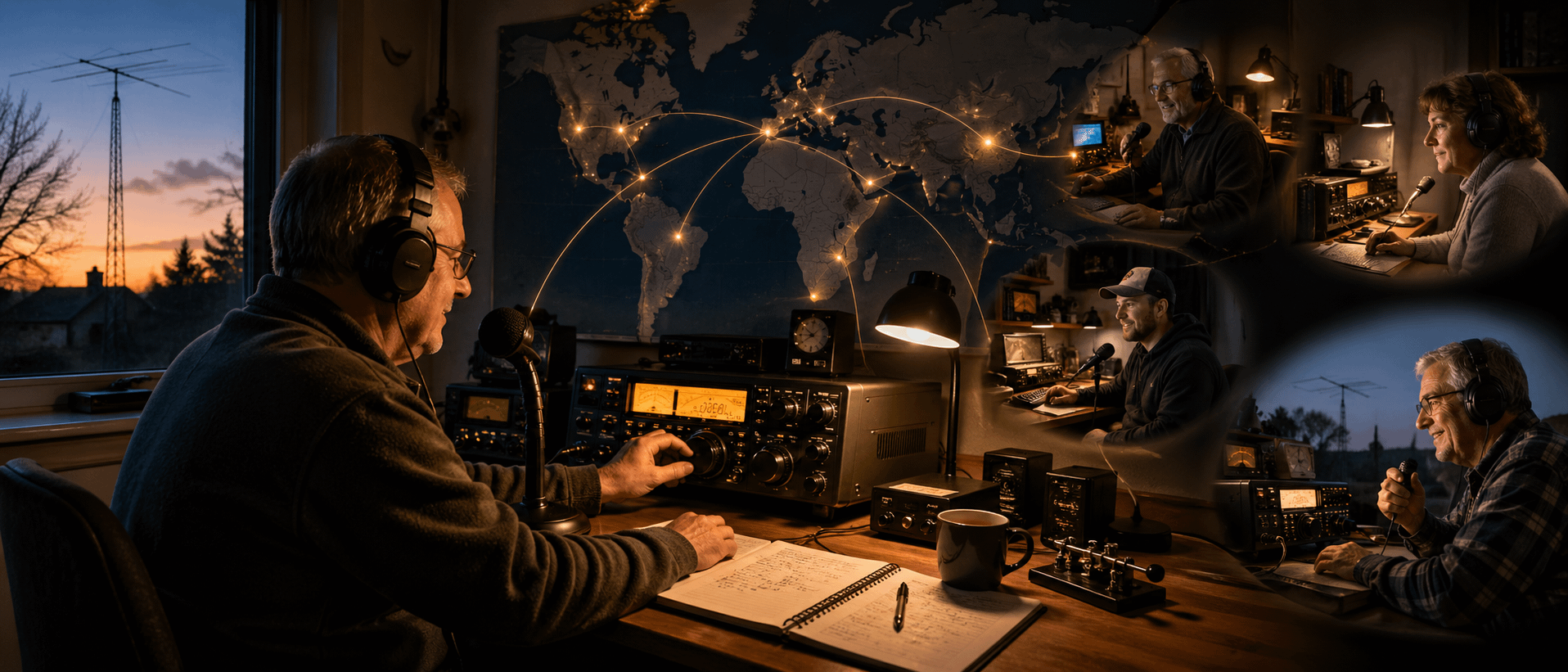
One of the best ways to become active in amateur radio is to take part in a club net. A net is a scheduled on-air gathering where radio operators meet on a particular frequency at a particular time. It gives members a regular opportunity to make contact, test equipment, share news and keep the club connected between meetings and events.
For beginners, a club net can be one of the easiest and friendliest ways to get on the air. For experienced operators, it is a useful routine that keeps operating skills sharp and helps maintain contact with other members.
What Is a Club Net?
A club net is a planned radio session where members call in, usually under the guidance of a net controller. The net controller opens the net, invites stations to check in, keeps order, manages the conversation and closes the session when finished.
A net might be informal and relaxed, or it may follow a more structured format. Either way, the basic idea is simple: operators gather on air at the same time so they can communicate as a group.
A typical club net may include:
- Calling for stations to check in
- Sharing signal reports
- Passing club announcements
- Discussing upcoming events
- Testing equipment and antennas
- Helping new operators build confidence
- Keeping in touch with members who cannot attend meetings
Kildare Amateur Radio Club HF Net
Kildare Amateur Radio Club runs a regular HF net every Thursday evening at 8.00pm.
The club net normally takes place on:
7.121 MHz or 3.690 MHz
The choice of frequency may depend on band conditions, interference and propagation on the evening. If one band is not performing well, the other may provide a better option.
This regular Thursday evening net is a great way for members to keep in touch, test their HF stations and welcome new operators onto the air.
Why Club Nets Matter
Club nets are more than just a weekly chat. They play an important role in keeping an amateur radio club active and connected.
1. They Keep Members Connected
Not everyone can attend every club meeting or event. A regular net gives members another way to stay involved. Even a short check-in allows people to hear familiar voices, share updates and remain part of the club community.
For members who live further away, have limited time, or cannot travel easily, the net can be an important connection to the club.
2. They Help Beginners Get on the Air
Making a first radio contact can be intimidating. A club net makes it easier because the setting is planned, friendly and supportive.
New operators can listen first, learn the format, and then join when ready. Other members will understand that beginners may be nervous and may need encouragement.
A club net helps beginners practise:
- Using their call sign correctly
- Calling into a net
- Giving and receiving signal reports
- Speaking clearly on air
- Listening before transmitting
- Understanding net procedure
- Building confidence
3. They Test Equipment and Antennas
A regular net is a practical way to check whether your radio station is working properly. You can quickly find out how your signal is being received by other stations.
This is especially useful after:
- Installing a new antenna
- Changing coax cable
- Moving equipment
- Adjusting an antenna tuner
- Trying a new microphone
- Testing portable power
- Returning to the hobby after a break
A signal report from another operator can tell you a lot about how your station is performing.
4. They Build Operating Discipline
Good amateur radio practice is learned by doing. Nets help operators develop clear, calm and disciplined communication habits.
This includes:
- Waiting your turn
- Keeping transmissions concise
- Leaving gaps between overs
- Avoiding doubling with other stations
- Listening carefully
- Passing information accurately
- Following the net controller’s direction
These habits are useful not only for club nets but also for contests, special event stations, portable operation and emergency communication exercises.
5. They Support Club Announcements
A club net is a useful way to remind members about upcoming activities. These might include club meetings, field days, talks, rallies, training sessions, special event stations or social events.
Because the net is live and interactive, members can ask questions, offer help or confirm attendance.
6. They Encourage Regular Radio Use
Many operators have good equipment but do not always use it regularly. A weekly net provides a reason to switch on the radio, check the bands and stay active.
Regular use also helps identify problems early. A radio station that is used often is more likely to be maintained, tested and ready when needed.
How to Take Part in a Club Net
Taking part in a net is straightforward. The most important thing is to listen first.
Step 1: Tune to the Frequency
For the Kildare Amateur Radio Club HF net, tune to 7.121 MHz or 3.690 MHz on Thursday evening before 8.00pm. Listen for activity and for the net controller calling the net.
Make sure your radio is set to the correct mode, normally LSB on 40 metres and 80 metres.
Step 2: Listen Before Transmitting
Do not transmit immediately. Listen to understand what is happening. The net controller may be calling for stations, acknowledging check-ins or managing a list of operators.
Listening first helps prevent doubling and keeps the net orderly.
Step 3: Check In When Invited
When the net controller asks for stations to call in, give your call sign clearly.
For example:
“EI___, good evening.”
Or:
“EI___ calling for the Kildare net.”
Keep it simple. The net controller will acknowledge you and may ask you to stand by until your turn.
Step 4: Give a Short Report
When invited to speak, give a brief update. This might include your name, location, signal report for the net controller and any short news or comments.
For example:
“Good evening. This is EI___ in Naas. You are 5 and 8 with me this evening. I am running 50 watts into a dipole. Good to hear everyone on the net.”
You do not need to make a long transmission. Short and clear is best, especially when several stations are waiting.
Step 5: Follow the Net Controller
The net controller keeps the session organised. Wait until you are called before transmitting. If you need to leave early, let the controller know when appropriate.
If you are unsure what to do, simply listen for a while. You will quickly understand the pattern.
Tips for Good Net Operation
To make the net enjoyable for everyone:
- Be on frequency a few minutes early
- Listen before calling
- Use your call sign clearly
- Keep comments concise
- Leave a small gap before replying
- Avoid talking over another station
- Give honest signal reports
- Be welcoming to new operators
- Follow the net controller’s lead
- Keep the tone friendly and respectful
What If You Cannot Hear Everyone?
On HF, it is normal that not every station can hear every other station. Propagation, distance, antenna type, power level and local noise all affect reception.
You may hear the net controller clearly but not hear some other members. Another operator may hear a station that you cannot. This is normal and is part of the learning experience.
If you are struggling to hear the net, try:
- Checking your antenna tuning
- Reducing local electrical noise
- Using headphones
- Trying the alternative frequency
- Checking whether 40 metres or 80 metres is better that evening
- Asking for reports from other stations
What Equipment Do You Need?
For the Kildare HF net, you will need access to an HF radio and a suitable antenna for 40 metres and/or 80 metres.
A typical setup might include:
- HF transceiver
- Power supply
- 40 metre or 80 metre antenna
- Antenna tuner, if needed
- Coax cable
- Headphones
- Logbook or notebook
You do not need a large or expensive station. Many operators take part using modest equipment and simple wire antennas.
Can Beginners Listen?
Yes. Listening is one of the best ways to learn. If you are not yet licensed, or not yet confident enough to transmit, tune in and listen. You will learn how the net operates, how stations identify themselves and how HF conditions change from week to week.
Listening regularly will make it much easier to join in when you are ready and licensed.
The Role of the Net Controller
The net controller has an important job. They open the net, call for stations, manage the order of speakers, deal with doubling, pass announcements and close the net.
A good net controller keeps the session friendly and organised. They also make space for new or weaker stations and may ask stronger stations to help relay reports if needed.
Over time, members may get the opportunity to act as net controller themselves. This is a useful skill and a good way to contribute to the club.
Why HF Nets Are Especially Interesting
HF nets are particularly enjoyable because band conditions change. One Thursday evening may bring strong signals across Ireland and Britain. Another evening may be noisy or difficult. The changing nature of HF makes every net slightly different.
The club’s use of 7.121 MHz or 3.690 MHz gives flexibility, as 40 metres and 80 metres can behave differently depending on time, season and propagation.
This makes the net both social and educational. Each week is a practical lesson in radio conditions.
Final Thoughts
Club nets are one of the simplest and most valuable activities in amateur radio. They keep members connected, help beginners build confidence, test equipment, share club news and strengthen operating skills.
For Kildare Amateur Radio Club members, the Thursday evening HF net is a regular opportunity to get on air and stay involved.
Tune in every Thursday at 8.00pm on 7.121 MHz or 3.690 MHz, listen for the net controller, and join in when you are ready.
Whether you are a new operator, an experienced member or someone simply listening to learn, the club net is a great reminder of what amateur radio is all about: communication, community and shared enthusiasm for radio.