

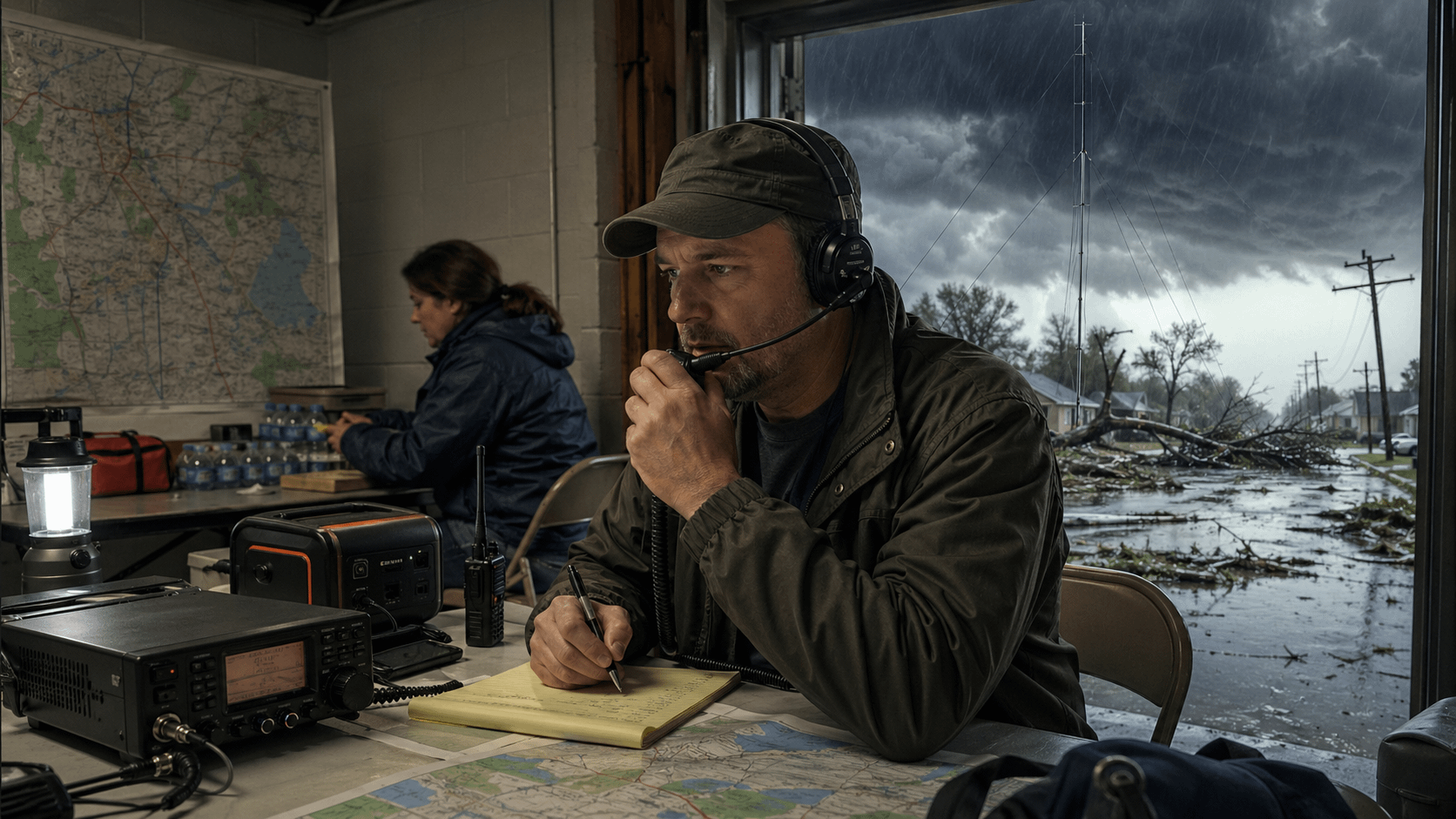
When most people think about emergency communication, they think of mobile phones, internet messaging, social media or emergency service radio systems. These technologies are essential, but they all depend on infrastructure: mobile masts, broadband networks, electricity, data centres and control systems. When storms, flooding, power cuts or other major incidents disrupt that infrastructure, communication can quickly become difficult.
This is where amateur radio can play a useful supporting role.
Amateur radio is not a replacement for the emergency services. It is not about taking over from Gardaí, fire services, ambulance services, Civil Defence or local authorities. Instead, amateur radio can provide an additional layer of communication when normal systems are overloaded, damaged or unavailable.
Why Amateur Radio Matters in an Emergency
Amateur radio is valuable because it can operate independently of many everyday communication networks. A licensed radio amateur can communicate using radios, antennas and independent power sources such as batteries, generators or solar panels.
This means that, in certain circumstances, amateur radio operators may be able to communicate when:
Mobile phone networks are congested or unavailable.
Electricity supply is disrupted.
Internet access is lost.
Remote areas are difficult to reach.
Local communication between volunteers is needed.
Weather, flooding or storm damage affects infrastructure.
In a serious incident, even simple communication can be important. Knowing whether a road is blocked, whether a community hall has power, whether volunteers have arrived, or whether a message has been passed on can make coordination easier.
What Amateur Radio Can Do
Amateur radio can support emergency situations in several practical ways.
1. Local Communication
VHF and UHF radios can be used for local communication across towns, villages and surrounding areas. With suitable antennas and repeaters, coverage can extend significantly beyond what a small handheld radio might achieve on its own.
This can be useful for community events, search support, local coordination, welfare checks and communication between locations where mobile coverage is weak.
2. Communication Without the Internet
Many modern systems depend on internet access. Amateur radio does not have to. A basic radio contact can be made directly from one station to another, or through a repeater, without relying on broadband, Wi-Fi or mobile data.
This makes radio a useful backup when digital networks are unavailable.
3. Portable and Field Operation
Radio amateurs often practise operating from temporary locations. They use portable antennas, battery power and compact radio equipment. These skills are directly relevant in situations where communication is needed away from a fixed station.
A portable station can be set up in a hall, car park, field, community centre or other suitable location. The ability to quickly establish a working communication point is one of the practical strengths of amateur radio.
4. Message Passing
In emergency communication, clear and accurate message handling is important. Amateur radio operators can be trained to pass short, structured messages accurately. This may include location details, status updates, resource requests or welfare information.
Good message handling is not about long conversations. It is about clarity, discipline and accuracy.
5. Wider-Area Communication
HF radio can allow communication over longer distances, sometimes across Ireland, Europe or further afield depending on conditions. This may be useful if local infrastructure is severely affected and communication needs to reach outside the immediate area.
HF communication depends on propagation conditions, but experienced operators understand how to choose suitable bands and times for best results.
What Amateur Radio Cannot Do
It is important to be realistic. Amateur radio is not a magic solution. It has limits.
Amateur radio cannot replace professional emergency communication systems. It cannot guarantee communication in every situation. It cannot be used for commercial traffic. Operators must remain within licence conditions and must act responsibly.
Amateur radio operators should not self-deploy into emergency situations or interfere with official operations. The most effective support happens when radio amateurs work in an organised way, through recognised structures and in cooperation with the relevant authorities or voluntary emergency organisations.
The role is support, not command.
Emergencies Where Radio May Help
Amateur radio may be useful in situations such as:
Severe storms
Flooding
Extended power cuts
Major community events
Communications blackspots
Search and rescue support
Public service events
Local welfare coordination
Infrastructure disruption
In Ireland, storms and localised flooding are realistic examples. Even when national systems remain operational, local communication can still be affected by power loss, damaged trees, blocked roads or poor mobile coverage.
The Importance of Preparation
Emergency communication is only useful if people prepare before an emergency happens. This is why amateur radio clubs practise portable operating, field days, radio nets and equipment testing.
Preparation includes:
Keeping radios charged and maintained.
Knowing local repeater frequencies.
Having suitable antennas available.
Practising clear operating procedures.
Testing battery power options.
Keeping contact lists and plans updated.
Learning how to pass messages accurately.
Working with clubs and local groups.
A radio stored in a box and never tested may not be much help when needed. A simple, tested station with an operator who knows how to use it is far more valuable.
Power Is a Key Issue
During an emergency, power may be limited. Amateur radio operators often use alternative power sources such as battery packs, leisure batteries, portable power stations or generators. Some also use solar panels for longer-duration operation.
Low-power communication can be very effective when paired with a good antenna. In many cases, improving the antenna is more useful than simply increasing transmitter power.
Community Value
One of the strengths of amateur radio is the community behind it. Clubs bring together people with practical knowledge of radios, antennas, electronics, local geography and communication procedures.
In a local emergency, that knowledge can be valuable. Operators may know which high points provide good coverage, which repeaters are active, what equipment is available, and how to establish communication quickly.
This community aspect is one reason amateur radio remains relevant, even in a world of smartphones and high-speed internet.
Training and Good Practice
Emergency communication requires more than owning a radio. It requires calm, disciplined operating. Operators need to know when to speak, what to say, how to keep messages short, and how to avoid blocking a frequency unnecessarily.
Good practice includes:
Listening before transmitting.
Using clear language.
Identifying correctly.
Keeping messages brief.
Avoiding speculation or rumours.
Recording important messages.
Following agreed procedures.
Respecting official communication channels.
In emergency situations, inaccurate information can create confusion. Radio operators must be careful, responsible and factual.
How Beginners Can Get Involved
If you are new to amateur radio and interested in emergency communication, the best first step is to join a local club. Learn the basics, get licensed, practise regularly and build your skills gradually.
You do not need to start with expensive equipment. A simple handheld radio, a better antenna and knowledge of local repeaters can be a useful beginning. Over time, you may explore mobile radios, portable antennas, battery systems, HF equipment and digital modes.
The most important thing is not the equipment. It is the ability to communicate clearly and reliably.
The Role of Kildare Amateur Radio Club
Kildare Amateur Radio Club can help local people understand how amateur radio works and how it may support communication during emergencies or public service activities. The club provides a place to learn, ask questions, see equipment in use and develop practical radio skills.
For beginners, the club can help explain:
How to get started in amateur radio.
What licence is required.
How repeaters work.
What equipment is suitable.
How to operate safely and responsibly.
How radio can support community resilience.
By building local knowledge and encouraging practical skills, amateur radio clubs help keep this valuable communication capability alive.
Final Thoughts
So, can amateur radio help during emergencies?
Yes, it can. But its value depends on preparation, training, organisation and responsible use. Amateur radio is most useful when operators are licensed, practised, well-equipped and connected with local clubs or recognised support structures.
Modern communication systems are powerful, but they are not invincible. Amateur radio provides an independent, flexible and practical backup that can still work when other systems fail.
For communities in Kildare and beyond, amateur radio offers more than a hobby. It offers a way to build skills, resilience and local connection — all of which can matter when communication becomes difficult.