
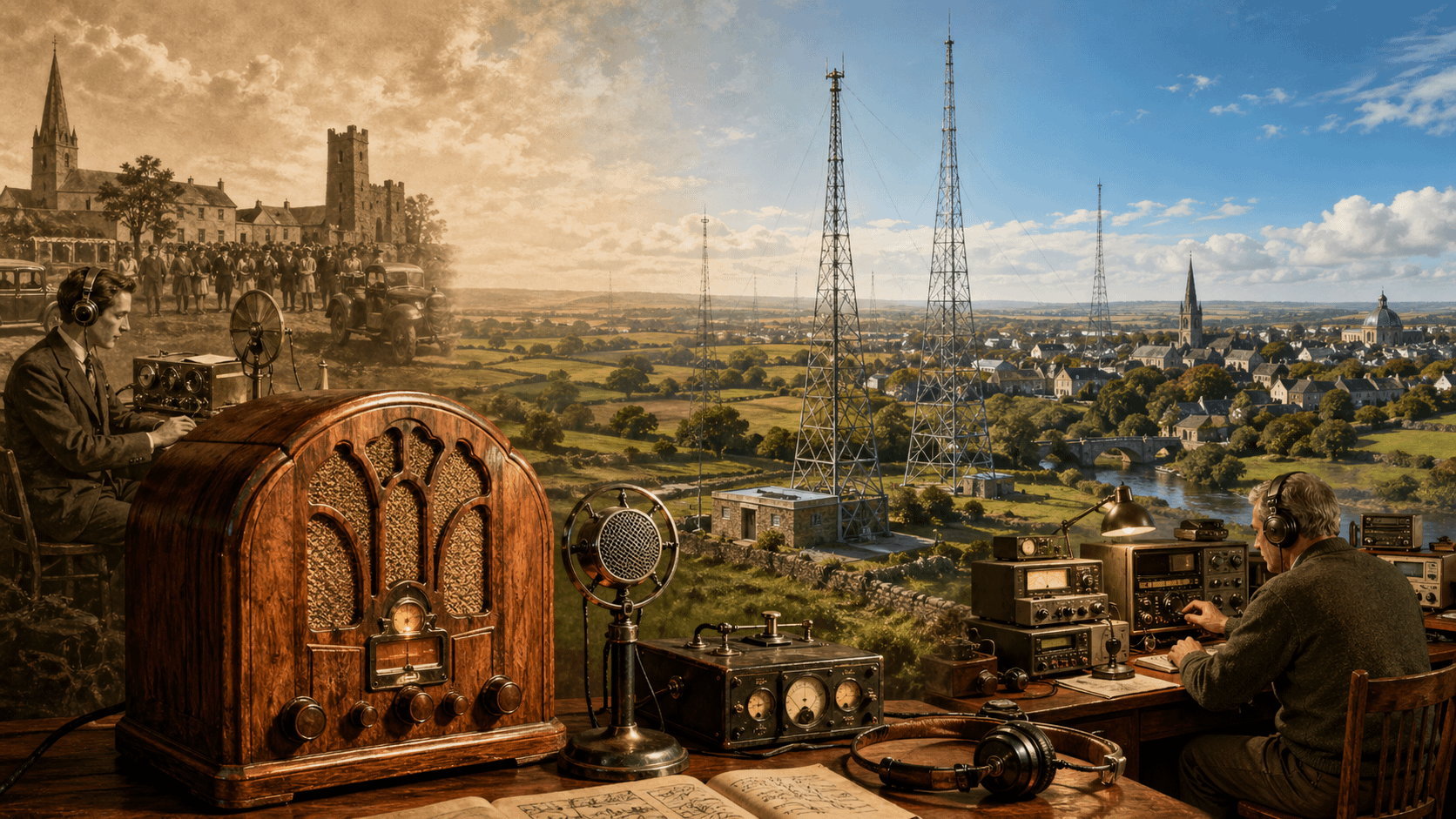
Radio has always had a special place in Irish life. Long before smartphones, broadband and social media, radio was how people heard the news, followed sport, listened to music, learned about the world and stayed connected with their community. In Kildare and the Midlands, radio history is especially interesting because this part of Ireland played an important role in both national broadcasting and local radio culture.
For amateur radio operators, this history matters. It reminds us that radio is not just about equipment and frequencies. It is about people, places, innovation and communication.
Radio Before the Internet Age
For much of the twentieth century, radio was the fastest way to reach people. Families gathered around radio sets for news, music, drama, religious services, sport and public announcements. In rural Ireland, radio helped connect homes and communities that were otherwise separated by distance.
The arrival of broadcasting changed everyday life. It brought national events into kitchens and sitting rooms. It gave people access to voices and stories from beyond their own townland. It also created a shared experience. When people heard the same broadcast at the same time, radio became part of the rhythm of national life.
This is one reason radio still holds such affection for many people. It was never only a technology. It was a companion.
Athlone: A Major Name in Irish Radio History
Any history of radio in the Midlands must mention Athlone. In the early decades of Irish broadcasting, Athlone became one of the most important radio locations in the country.
Ireland’s first national broadcasting station, 2RN, began regular broadcasting from Dublin on 1 January 1926. However, early coverage was limited, and many listeners outside Dublin found reception difficult. A more powerful national transmitter was needed to reach a wider audience. RTÉ Archives records that a new high-powered station at Athlone was officially opened on 6 February 1933 by Éamon de Valera, then President of the Executive Council.
This was a significant moment. Athlone’s central location made it suitable for national coverage, and the name “Radio Athlone” became familiar to listeners across Ireland. RTÉ’s own historical material notes that 2RN covered the 1932 Eucharistic Congress using the new high-powered Athlone transmitter, initially 60 kW and later increased to 100 kW.
For many years, the phrase “Athlone calling” carried real meaning. It represented a time when radio signals from the Midlands reached homes throughout the country and beyond.
Tullamore and the Era of Powerful AM Broadcasting
The Midlands continued to play an important role in national broadcasting with the later development of the Tullamore transmitter in County Offaly. The Tullamore medium-wave transmitter carried RTÉ Radio 1 on 567 kHz and became one of the most recognisable broadcast sites in the country. The site’s mast was widely noted as one of Ireland’s tallest structures, and the transmitter remained part of Ireland’s AM broadcasting infrastructure until the closure of RTÉ medium-wave services in 2008.
For radio enthusiasts, stations such as Athlone and Tullamore are more than technical sites. They represent the era when AM radio carried national broadcasting over long distances, especially after dark when medium-wave signals could travel far beyond their daytime range.
Many older listeners and shortwave enthusiasts will remember tuning across the dial and hearing powerful broadcast signals fade in and out, sometimes mixed with stations from Britain, Europe and further afield.
Kildare’s Local Radio Story
Kildare also has its own local radio history. Before the modern licensed local radio system became established, Ireland had a lively period of unlicensed or “pirate” radio. These stations often emerged because communities wanted more local voices, local music, local sport, requests, dedications and information that national broadcasting did not always provide.
The Irish Pirate Radio Audio Archive records that Kildare Community Radio, known as KCR, broadcast from Naas from 1979 until 1988. The archived description gives a sense of the station’s local flavour, with music, requests, dedications and listener interaction forming an important part of its output.
Another Kildare example was Kildare Local Broadcasting, known on air as KLB Community Radio. According to the same archive, KLB broadcast from Newbridge for approximately two years from 1986 to 1988, operating on 1224 kHz AM and 102.4 FM.
These stations reflected something important: people wanted radio that sounded like their own place. They wanted local accents, local news, local events and local personalities.
Pirate Radio and Community Identity
The pirate radio era in Ireland was not simply about music. It was also about community identity. Many towns and regions felt underrepresented by national broadcasting. Local stations filled that gap by talking about local matches, local businesses, local traffic, local events and local concerns.
The Midlands had its own strong pirate radio culture. The Irish Pirate Radio Audio Archive notes, for example, that Radio West was a popular Midlands station in the early 1980s and that many such stations outside Dublin became templates for the licensed local radio services that followed.
This is an important point. The pirate stations were technically illegal, but many of them demonstrated that local radio had a real audience and a real purpose. When legal independent local radio developed in Ireland, it built on public demand that had already been clearly demonstrated.
Amateur Radio: A Different but Connected Tradition
Amateur radio is different from broadcast radio. Broadcasters transmit programmes to the public. Amateur radio operators communicate with one another using licensed frequencies for learning, experimentation and non-commercial communication.
However, the two worlds are connected by a shared fascination with radio waves, antennas, propagation, equipment and communication. Many people who became amateur radio operators first became interested in radio by listening to broadcast stations, pirate radio, shortwave signals, aircraft, marine traffic or distant AM stations late at night.
For some, the journey began by turning a tuning dial and wondering: Where is that signal coming from? How far has it travelled? Could I send a signal too?
That curiosity is at the heart of amateur radio.
The Role of Clubs in Preserving Radio Culture
Local amateur radio clubs help keep this radio tradition alive. They give people a place to learn about operating, antennas, equipment, licensing, safety and radio history. They also create opportunities to activate special event stations, support public demonstrations and introduce newcomers to the hobby.
Kildare Amateur Radio Club, using the club callsign EI0K, continues that tradition through club activities and special event operations. The club has, for example, activated EI0K for local historical and cultural themes, including an Arthur Guinness 300th birthday event in September 2025.
Special event stations are a good example of how amateur radio links communication with history. A radio contact becomes more than a technical exchange. It becomes a way to tell a local story and put a place on the air.
Why Local Radio History Still Matters
It would be easy to think that radio history belongs to the past. But it still matters today for several reasons.
First, it shows how communication shaped community life. Before the internet, radio helped people feel connected to events beyond their immediate surroundings.
Second, it reminds us that infrastructure matters. The location of transmitters such as Athlone and Tullamore was not accidental. Geography, coverage and engineering all shaped how Ireland heard itself.
Third, it shows the importance of local voices. The growth of local and community radio reflected a real need for local identity in broadcasting.
Finally, it encourages technical curiosity. Radio history is full of people experimenting, building, listening, transmitting and improving what came before.
Radio in the Digital Age
Today, most people carry powerful communication devices in their pockets. They can stream radio online, listen to podcasts, send messages instantly and watch live video from anywhere. But this does not make radio irrelevant.
Radio remains valuable because it is direct, practical and independent. Amateur radio in particular continues to teach skills that modern devices often hide: how signals travel, how antennas work, how to communicate clearly, and how to operate when normal systems are unavailable.
Modern amateur radio has also embraced digital technology. Operators use software-defined radio, digital modes, satellite tracking, computer logging, online mapping and internet-linked systems. The hobby has evolved while keeping its core spirit of experimentation.
A Kildare and Midlands Radio Heritage Trail
For anyone interested in radio history, Kildare and the Midlands offer several themes worth exploring:
Athlone and the birth of high-power national broadcasting.
Tullamore and the era of powerful AM transmission.
Naas and Newbridge in the local radio and pirate radio era.
The development of licensed local radio across the Midlands.
Amateur radio clubs and special event stations.
Portable operating from local high points, heritage sites and community locations.
Each of these tells part of the story of how radio connected people across Ireland.
Bringing the Story to a New Generation
One of the challenges for amateur radio clubs is introducing younger people to radio in a world dominated by phones and apps. Local history can help.
When people realise that radio is not just an old technology, but a living part of local and national history, it becomes more interesting. A demonstration of amateur radio can be linked to stories about Athlone, Tullamore, Kildare pirate radio, emergency communication, local events and international contacts.
For a young person, hearing a signal from another country or seeing a portable station make a contact from a field can still create the same sense of wonder that earlier generations felt when they first tuned across the dial.
Final Thoughts
The radio history of Kildare and the Midlands is rich and varied. It includes national broadcasting from Athlone, powerful AM transmission from Tullamore, local pirate stations in Naas and Newbridge, community voices across the Midlands, and today’s amateur radio activity.
This history reminds us that radio has always been about connection. It connects towns, counties and countries. It connects generations. It connects technical curiosity with community spirit.
For Kildare Amateur Radio Club, local radio history is not just something to remember. It is something to build on. Every club net, field day, special event station and new operator continues the story of radio in Kildare and the Midlands.