

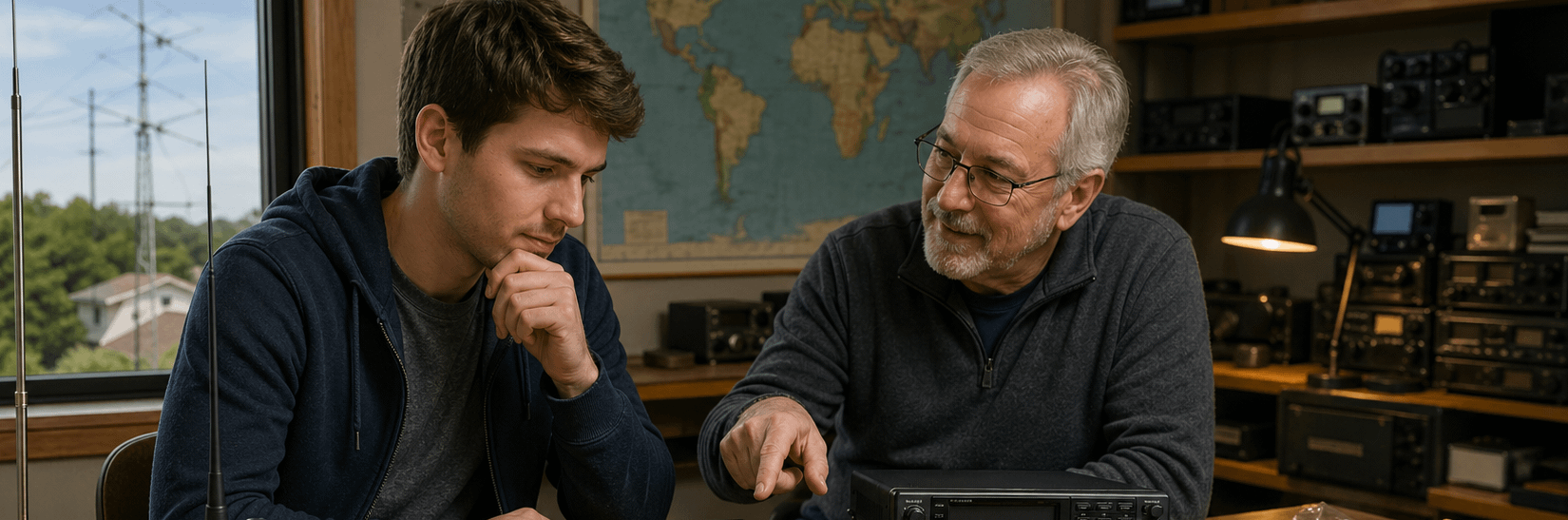
Buying your first ham radio is exciting, but it can also be confusing. There are handheld radios, mobile radios, base stations, HF rigs, digital radios, antennas, power supplies, cables, microphones and accessories. A beginner can easily spend too much money, buy the wrong equipment, or end up with a radio that does not suit their needs.
The good news is that you do not need to buy everything at once. Amateur radio is best learned gradually. Start with simple, reliable equipment, learn how to use it properly, and then expand as your interests develop.
This guide is written for newcomers who are interested in amateur radio and want practical advice before making their first purchase.
Start With the Question: What Do You Want to Do?
Before buying a radio, ask yourself what type of amateur radio activity interests you most.
Do you want to:
- Talk to local operators?
- Use local repeaters?
- Join club nets?
- Operate from the car?
- Make contacts around Ireland and Europe?
- Try long-distance international communication?
- Go portable from parks, hills or field days?
- Experiment with antennas?
- Explore digital modes?
- Prepare for backup or emergency communication?
Different activities require different equipment. A handheld radio may be ideal for local repeater use, but it will not give you the same experience as an HF radio for long-distance contacts. An HF base station may be excellent for worldwide communication, but it may be too expensive or complicated as a first step.
The best first radio is not always the most powerful or most expensive one. It is the one that helps you get on the air and learn.
Do You Need a Licence Before Buying?
You do not need an amateur radio licence to buy equipment or listen. However, you do need the appropriate licence before transmitting on amateur radio frequencies.
Many beginners buy a receiver, scanner, software-defined radio, or handheld transceiver so they can listen while studying for the licence. Listening is an excellent way to learn operating style, call signs, repeaters, nets and band activity.
If you are not yet licensed, make sure you understand the rules before pressing the transmit button.
Option 1: A Handheld VHF/UHF Radio
For many beginners, the first radio is a handheld VHF/UHF transceiver, often called an HT or handheld. These radios are compact, portable and relatively affordable. They are commonly used for local communication and repeaters.
A handheld radio is good for:
- Listening to local repeaters
- Making local contacts once licensed
- Club nets
- Portable use
- Learning basic radio operation
- Emergency backup communication
- Carrying to club events and field days
A basic handheld is often the simplest way to get started, especially if there are active repeaters in your area.
What to Look for in a Beginner Handheld
When choosing a handheld radio, look for:
- VHF/UHF coverage, usually 2 metres and 70 centimetres
- Good battery life
- Clear audio
- Easy programming
- CTCSS tone support for repeaters
- Reliable charger
- Replaceable antenna
- Good build quality
- Availability of programming cable and software
- Support from other local users
Ease of use matters. Some very cheap radios work, but they can be awkward to programme and may have poor manuals. If several club members use the same model, it may be easier to get help.
What to Avoid in a Handheld
Avoid choosing a handheld based only on the lowest price. A very cheap radio may seem attractive, but it can bring problems.
Watch out for:
- Poor receiver performance
- Confusing menus
- Weak battery life
- Low-quality chargers
- Poor-quality antennas
- No clear manual
- Difficult programming
- Questionable compliance or filtering
- Lack of local support
A cheap handheld may still be useful, but it should not be your only guide to the hobby. If the radio is frustrating to use, it may discourage you before you really get started.
The Antenna Is Often More Important Than the Radio
One of the most common beginner mistakes is focusing only on the radio and ignoring the antenna. The antenna has a huge effect on performance.
The small rubber antenna supplied with many handhelds is convenient, but it is often limited. A better antenna can make a noticeable difference.
Useful beginner antenna upgrades include:
- A better handheld whip antenna
- A magnetic mount antenna for the car
- A simple external antenna for home use
- A roll-up J-pole antenna for portable use
- A small vertical antenna mounted higher up
Height helps. Even a modest antenna placed near a window or outdoors can perform much better than a handheld used indoors.
Option 2: A Mobile VHF/UHF Radio
A mobile radio is usually designed for use in a car, but it can also be used at home with a suitable power supply. Mobile radios generally offer more power than handhelds and better performance.
A mobile VHF/UHF radio is good for:
- Car operation
- Stronger access to repeaters
- Local simplex contacts
- Club nets
- Home station use with an external antenna
- Public service or event communication
If you spend time driving or live slightly outside repeater coverage, a mobile radio can be a very practical first or second radio.
What You Need With a Mobile Radio
A mobile radio usually needs additional equipment:
- 12V power supply if used at home
- External antenna
- Coax cable
- Mounting bracket
- Microphone
- Power cable and fuse
- Possibly a mag-mount antenna for the car
Do not forget these costs. The radio itself is only part of the station.
What to Avoid With Mobile Radios
Avoid installing a mobile radio in a car without thinking about safety and power. Poor wiring can cause problems. Always use appropriate fusing and safe cable routing.
Avoid using a mobile radio at home with an unsuitable power supply. Radios need a stable power source capable of supplying enough current.
Also avoid buying a high-powered mobile radio if you only intend to use it with a poor indoor antenna. A modest radio with a good antenna will often work better than a powerful radio with a bad antenna.
Option 3: An HF Radio
HF radio is where many people experience the magic of amateur radio: making contacts across Ireland, Europe and the world. HF uses lower frequencies than VHF/UHF and can support long-distance communication depending on propagation conditions.
An HF radio is good for:
- Long-distance contacts
- International communication
- Voice, Morse and digital modes
- Contesting
- Special event stations
- Portable operation
- Antenna experimentation
HF can be extremely rewarding, but it is usually a bigger investment than a handheld or mobile VHF/UHF radio.
What You Need for HF
An HF station usually includes:
- HF transceiver
- Power supply
- Suitable antenna
- Coax cable
- Earth/grounding arrangements where appropriate
- Antenna tuner if needed
- Logging method
- Possibly a computer interface for digital modes
The antenna is a major consideration. Before buying an HF radio, think carefully about what antenna you can install. Do you have space for a wire antenna? Can you put up a vertical? Are you in an apartment? Are there planning or landlord restrictions?
HF is very possible from small spaces, but it requires planning.
Should a Beginner Buy an HF Radio First?
Some beginners do start with HF, especially if their main interest is long-distance communication. However, many people find it easier to begin with VHF/UHF and local repeaters, then move into HF later.
HF has more variables: band conditions, antennas, tuning, noise, grounding, propagation and operating technique. These are enjoyable challenges, but they may feel overwhelming at first.
If you are very interested in HF, ask a club member to demonstrate a station before you buy. Seeing HF in operation will help you make a better decision.
New or Second-Hand?
Both options can work.
A new radio gives you warranty, dealer support and confidence that the equipment should work correctly. It may be the safer option for a beginner who does not yet know how to assess used equipment.
Second-hand equipment can offer excellent value, especially if bought from a trusted club member or reputable seller. Many operators take great care of their equipment, and older radios can perform very well.
However, second-hand purchases require caution. If possible, see the equipment working before buying.
What to Check When Buying Second-Hand
Before buying used radio equipment, check:
- Does it power on correctly?
- Does it receive properly?
- Does it transmit at expected power?
- Are the controls working?
- Is the display clear?
- Are there signs of damage or modification?
- Is the microphone included?
- Are power cables included?
- Is the manual available?
- Has it been used in a clean environment?
- Can the seller demonstrate it?
For HF equipment, it is useful to test it into a dummy load and confirm output on different bands. If you are unsure, bring an experienced operator with you.
Accessories Worth Buying Early
Some accessories are genuinely useful for beginners.
Consider:
- A programming cable for handhelds or mobile radios
- A better antenna
- A spare battery
- A speaker microphone for handheld use
- A notebook or logging app
- A simple SWR meter for VHF/UHF or HF, as appropriate
- Good coax cable
- Adapters for common connectors
- A basic toolkit
- Headphones for listening
Buy accessories that solve real problems. Do not buy a box full of gadgets before you know what you need.
Accessories to Avoid at the Start
Avoid buying too many accessories too soon. Beginners often purchase items because they look useful, but later discover they do not match their radio, antenna or operating style.
Be cautious with:
- Unnecessary amplifiers
- Very cheap power supplies
- Poor-quality coax cable
- Random adapters of unknown quality
- Complicated antenna tuners you do not yet need
- Digital interfaces before you understand your radio
- Expensive microphones before improving your antenna
- Large antennas without installation planning
Spend slowly and learn as you go.
Do Not Start With an Amplifier
One of the worst beginner mistakes is thinking more power is the answer to every problem. In amateur radio, the antenna, location and operating skill usually matter more.
An amplifier will not fix a poor antenna, bad coax, high noise level or incorrect radio setup. It may simply make your problems louder.
Before considering an amplifier, learn how to:
- Install a suitable antenna
- Check SWR
- Reduce interference
- Choose the right band
- Use correct operating technique
- Understand propagation
For most beginners, an amplifier should be far down the list.
Power Supplies: Do Not Cut Corners
If you are using a mobile or base radio at home, you will need a suitable power supply. Radios need stable DC power and enough current capacity.
A poor-quality power supply can cause noise, instability or even damage. Choose a reputable supply with adequate current rating for your radio.
For portable use, batteries are often a better choice. Many operators use lithium battery packs or leisure batteries for field days and outdoor operation.
Coax Cable Matters
Coax cable connects your radio to your antenna. Poor coax can waste signal, introduce loss and cause frustration.
For short VHF/UHF runs, decent coax is important. For longer runs, especially on UHF, low-loss cable becomes even more important. For HF, losses are usually less severe, but quality still matters.
Avoid unknown old cable unless it has been checked. Water-damaged coax can perform very badly.
Software-Defined Radio as a Listening Option
If you are not ready to transmit, a software-defined radio, or SDR, can be a low-cost way to explore radio. An SDR receiver connects to a computer and allows you to see and hear signals across different parts of the spectrum.
SDR is good for:
- Learning about signals
- Listening to broadcast bands
- Exploring amateur bands
- Watching band activity visually
- Understanding frequency and modulation
- Shortwave listening
An SDR does not replace a transmitting radio, but it can be a very useful learning tool.
Ask the Club Before You Buy
One of the best pieces of advice is simple: ask experienced operators before spending money.
A local club can help you avoid common mistakes. Club members may know which repeaters are active, which radios are easy to programme, what antennas work well locally, and what second-hand equipment is worth considering.
Kildare Amateur Radio Club can help beginners understand the options and choose equipment that suits their goals, budget and location.
A Sensible First Setup
For many beginners, a sensible first setup might be:
- A reliable dual-band VHF/UHF handheld
- Programming cable
- Better antenna
- Spare battery
- Access to local repeater information
- Notebook or logging app
- Support from a local club
This setup is not too expensive and gives you a practical way to listen, learn and make local contacts once licensed.
A second step might be:
- A mobile VHF/UHF radio
- External antenna
- Proper power supply for home use
- Mag-mount antenna for the car
A later step might be:
- HF transceiver
- Suitable HF antenna
- Power supply
- Antenna tuner if needed
- Digital mode interface if required
This staged approach keeps costs under control and allows your interests to guide your purchases.
Questions to Ask Before Buying Any Radio
Before buying, ask:
- What bands does it cover?
- Is it suitable for my licence level?
- Is it easy to programme?
- Can I get help locally?
- What antenna will I use with it?
- What accessories are required?
- Is there a manual?
- Is it supported by programming software?
- What is the total cost of the complete setup?
- Will it help me do what I actually want to do?
The total setup matters more than the radio alone.
Common Beginner Buying Mistakes
Avoid these common mistakes:
- Buying before understanding your goals
- Spending too much too soon
- Buying a radio without considering the antenna
- Choosing the cheapest option without support
- Buying second-hand equipment untested
- Ignoring power supply requirements
- Buying an amplifier too early
- Assuming HF is impossible from a small space
- Assuming a handheld will work everywhere indoors
- Not joining a club before purchasing
Most mistakes can be avoided by asking questions first.
Final Thoughts
Your first ham radio does not need to be expensive or complicated. The best choice is usually a simple, reliable radio that helps you learn and get involved. For many beginners, that means starting with a dual-band handheld and local repeaters. For others, it may mean a mobile radio, an SDR receiver, or an HF setup with guidance from experienced operators.
Whatever you buy, remember that the radio is only one part of the station. Antennas, power, location, programming and operating skill all matter.
Start simple. Listen often. Ask for advice. Learn by doing. Upgrade only when you understand what you need next.
Amateur radio is a hobby with endless possibilities, but every operator starts somewhere. With the right first radio and good support from a local club, your first step into the hobby can be enjoyable, affordable and rewarding.