

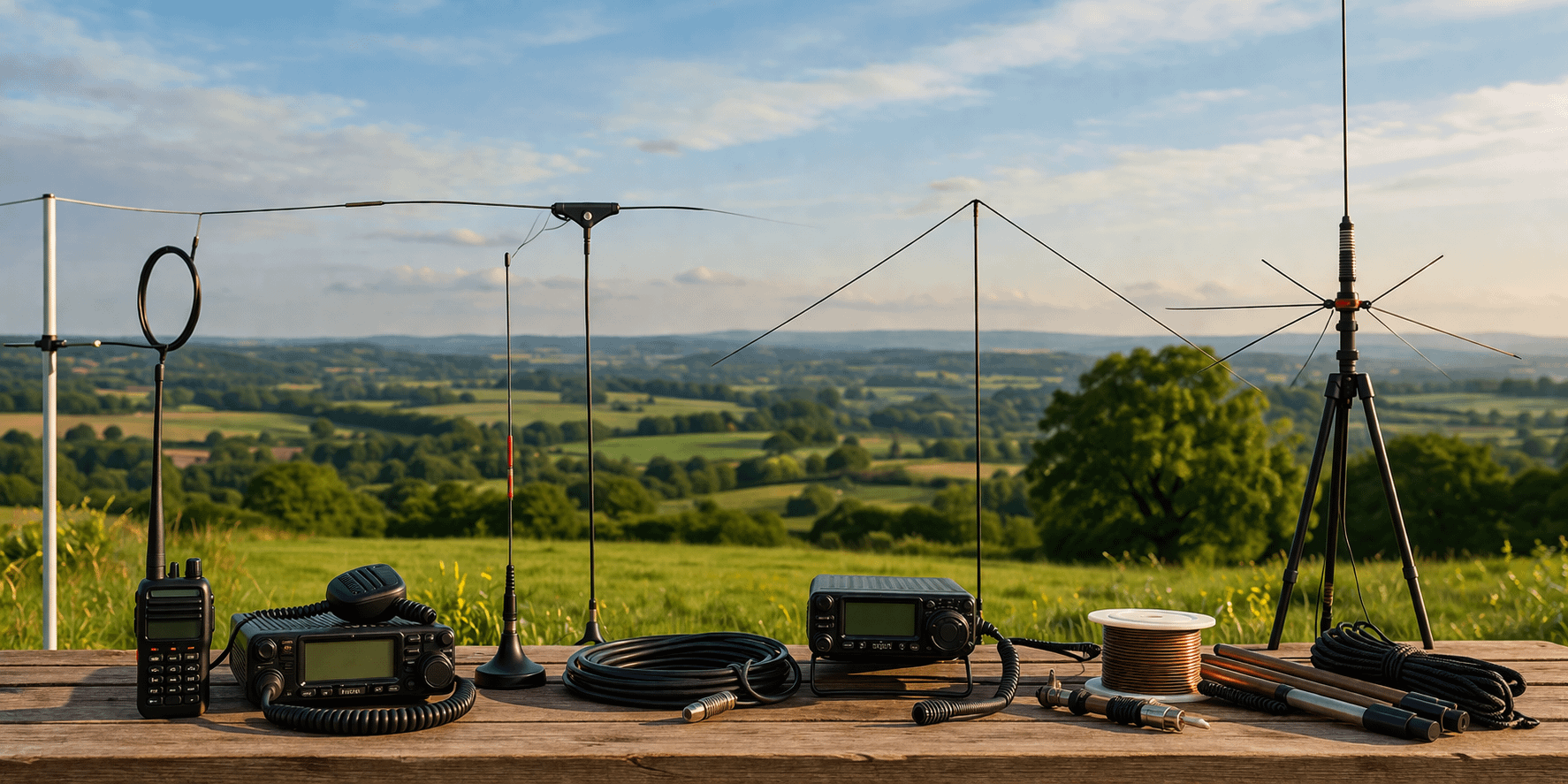
When people first get involved in amateur radio, they often focus on the radio itself. They compare handhelds, mobile rigs, HF transceivers, power output, displays and features. But experienced operators will usually tell you the same thing: the antenna is one of the most important parts of your station.
A modest radio connected to a good antenna will often perform better than an expensive radio connected to a poor one. The antenna is what actually sends your signal into the air and collects signals from other stations. If the antenna is badly chosen, poorly positioned or incorrectly connected, even the best radio will struggle.
The good news is that beginner antennas do not need to be complicated. Some of the most effective antennas are simple, affordable and easy to understand.
What Does an Antenna Do?
An antenna converts electrical energy from your radio into radio waves that travel through the air. When receiving, it does the opposite: it collects radio waves and converts them into tiny electrical signals that your receiver can process.
In simple terms, the antenna is the bridge between your radio and the outside world.
The performance of an antenna depends on several factors, including:
Antenna type
Frequency band
Length
Height
Location
Surroundings
Coax cable quality
How well it is matched to the radio
For beginners, the most important lesson is this: a simple antenna in a good location can work very well.
Start With the Band You Want to Use
Before choosing an antenna, you need to know which band you want to operate on. Different amateur radio bands use different wavelengths, which means antennas are usually different sizes.
For beginners, the most common starting points are:
VHF and UHF
These are commonly used for local contacts, handheld radios, mobile radios and repeaters. Typical beginner bands include 2 metres and 70 centimetres.
HF
These bands are used for longer-distance contacts around Ireland, Europe and the world. HF antennas are usually larger because the wavelengths are longer.
A small antenna that works well on VHF may not work properly on HF. Likewise, a long wire antenna for HF may not suit a handheld VHF radio. Always match the antenna to the frequency range you want to use.
The Handheld Radio Antenna
Many beginners start with a handheld radio. These usually come with a small flexible antenna, often called a “rubber duck” antenna.
This antenna is convenient, but it is usually a compromise. It is short, easy to carry and durable, but it may not perform very well indoors or from a poor location.
If you are using a handheld and struggling to reach a repeater, the radio may not be the problem. The antenna and your position may be the real issue.
Simple ways to improve handheld performance include:
Moving closer to a window
Going outdoors
Standing on higher ground
Using a better replacement whip antenna
Using a magnetic mount antenna near a window or on a car
Connecting to an external antenna
Even small improvements in antenna height and position can make a big difference.
A Better Whip Antenna
One of the easiest upgrades for a handheld radio is a better whip antenna. These are longer than the standard antenna and are designed to perform better on VHF and UHF.
A longer whip can help you:
Hear repeaters more clearly
Access repeaters more reliably
Improve local simplex contacts
Reduce frustration with weak signals
However, longer is not always better. Very long flexible antennas can put strain on the radio connector and may be awkward to carry. Choose a sensible, well-reviewed antenna that suits your radio and connector type.
The Magnetic Mount Antenna
A magnetic mount antenna, often called a mag-mount, is a popular beginner antenna for VHF and UHF. It is commonly placed on the roof of a car, where the metal body acts as a ground plane.
A mag-mount can also be used at home if placed on a suitable metal surface, such as a baking tray, filing cabinet or metal plate near a window. This is not always perfect, but it can work surprisingly well.
A mag-mount antenna can be useful for:
Mobile operation
Improving handheld performance
Accessing repeaters from home
Temporary setups
Learning about antenna placement
If using a mag-mount on a car, make sure the coax cable is routed safely and does not interfere with driving. Remove the antenna before entering low garages or car washes.
The Simple VHF/UHF Vertical Antenna
For local repeater use, a vertical antenna is often the best choice. Most handhelds, mobile stations and repeaters use vertical polarisation, so a vertical antenna keeps your signal aligned with other stations.
A basic VHF/UHF vertical mounted outdoors and high up can provide excellent results. It does not need to be huge. Even a compact antenna placed above roof level can greatly improve performance compared with a handheld indoors.
When installing a vertical antenna, think about:
Height
Clear surroundings
Secure mounting
Good coax cable
Weatherproofing
Safe cable routing
Distance from power lines
Never install antennas near overhead electrical cables. Safety must come first.
The Roll-Up J-Pole
A roll-up J-pole is a simple and popular portable antenna for VHF and UHF. It is often made from ladder line or twin-lead cable and can be rolled up for transport.
It can be hung from a tree, window, fishing pole or temporary support. Many operators use roll-up antennas for field days, holidays, emergency kits and portable operation.
The roll-up J-pole is attractive because it is:
Lightweight
Portable
Affordable
Easy to store
Better than most handheld antennas
Suitable for temporary use
For a beginner, it is a great example of how a simple antenna can dramatically improve a small radio.
HF Antennas: Bigger but Still Simple
HF antennas are usually larger than VHF/UHF antennas because HF wavelengths are longer. This can make them seem intimidating, but many HF antennas are simple wires.
You do not need a large tower or complex beam antenna to enjoy HF. Many operators make successful contacts using simple wire antennas in gardens, between trees, along fences, or from portable masts.
The key is to start with a practical design and learn how it behaves.
The Dipole Antenna
The dipole is one of the classic beginner HF antennas. It consists of two lengths of wire connected at the centre to a feedline. It is simple, effective and widely understood.
A dipole can be used for a single band or designed to work on multiple bands with suitable adjustments or a tuner.
A basic dipole is good because it is:
Simple to build
Inexpensive
Effective
Easy to understand
A good learning antenna
Suitable for home or portable use
A dipole can be installed horizontally, as an inverted V, or in other practical arrangements depending on space. For many beginners, an inverted V is easier because it only needs one central support.
The End-Fed Wire Antenna
An end-fed wire is another popular HF antenna. Instead of being fed in the middle like a dipole, it is fed at one end. This can make installation easier, especially if you only have one good support point.
End-fed antennas are common for portable operation and small gardens. They can work very well when installed correctly, but they usually require a matching unit or transformer.
Advantages include:
Easy deployment
Good for limited spaces
Useful for portable work
Can cover multiple bands with the right design
Only needs one high support point
Beginners should be aware that end-fed antennas can sometimes bring RF back into the shack if not set up properly. Good matching, counterpoise arrangements and careful installation help avoid problems.
The Random Wire Antenna
A random wire antenna is a length of wire connected through a suitable tuner or matching unit. Despite the name, it should not be completely random in practice. Some wire lengths work better than others, and some can be difficult to tune.
Random wires are often used when space is limited. They can be effective, but beginners should learn the basics of matching and earthing before relying on one.
A random wire may be useful if:
You have limited space
You want a temporary receiving antenna
You are experimenting
You have a suitable tuner
You understand the need for safe installation
For transmitting, make sure the antenna system is properly matched and safe.
The Vertical HF Antenna
An HF vertical antenna can be useful when horizontal space is limited. Verticals can work well for longer-distance contacts, particularly when installed with a good radial system.
However, verticals are not magic. They often need radials or a good ground system to perform properly. A poor vertical with no radials may disappoint.
A vertical may be suitable if:
You have limited garden space
You want a compact HF option
You can install radials
You want low-angle radiation for DX
You can mount it safely outdoors
For beginners, the most important point is that the radial system is part of the antenna. Do not ignore it.
Receive-Only Antennas
If you are not licensed yet, or if you simply enjoy listening, a receive-only antenna can be a great starting point. A simple length of wire connected to a receiver or software-defined radio can open up shortwave listening.
With a basic receiving setup, you can explore:
Broadcast stations
Amateur bands
Airband
Marine signals
Weather transmissions
Digital signals
Shortwave activity
Listening helps beginners understand how bands behave at different times of day and under different conditions.
SWR: What Beginners Need to Know
SWR stands for Standing Wave Ratio. It is a measure of how well your antenna system is matched to your radio.
A high SWR can mean that power is being reflected back towards the radio rather than being radiated efficiently by the antenna. Most modern radios will reduce power or protect themselves if the SWR is too high.
Beginners do not need to become SWR experts immediately, but they should understand that an antenna should be checked before transmitting, especially on HF or with a new installation.
A suitable SWR meter or antenna analyser can help you check whether your antenna is working within a safe range.
Antenna Tuners: What They Do and Do Not Do
An antenna tuner can help match the antenna system to the radio. This allows the radio to operate safely and efficiently into a wider range of antenna impedances.
However, a tuner does not magically make a poor antenna good. It may make the radio happy, but it does not guarantee that the antenna is radiating well.
Think of a tuner as a matching tool, not a substitute for a suitable antenna.
Height and Location Matter
Height is often one of the easiest ways to improve antenna performance. An antenna placed higher and in the clear usually works better than one hidden indoors or blocked by buildings.
For VHF and UHF, height is especially important because signals often travel by line of sight. Moving an antenna upstairs, outdoors or onto higher ground can transform performance.
For HF, height also matters, but the best arrangement depends on the band and type of contact you want. A lower dipole may work well for regional contacts, while a higher antenna may improve longer-distance performance.
Safety First
Antenna work can be dangerous if done carelessly. Always take safety seriously.
Important safety rules include:
Keep antennas away from overhead power lines
Do not climb roofs or ladders without proper precautions
Secure masts and supports properly
Avoid creating trip hazards with wires or guy ropes
Weatherproof outdoor connections
Disconnect antennas during storms where appropriate
Do not overload structures
Respect neighbours and public spaces
No radio contact is worth an accident.
Indoor Antennas: Are They Worth Trying?
Many beginners cannot install outdoor antennas. They may live in apartments, rented homes or areas with restrictions. Indoor antennas are not ideal, but they can still be useful.
Indoor options include:
Handheld antennas near windows
Mag-mount antennas on metal surfaces
Compact loops
Short receiving wires
Portable antennas temporarily placed indoors
Balcony antennas where allowed
Indoor antennas may pick up more electrical noise from household devices. They may also be less efficient. But they are still worth trying, especially for listening and local repeater use.
Portable Antennas
Portable antennas are excellent for beginners because they allow experimentation without permanent installation. You can set up in a garden, park, field day or hilltop and see what works.
Portable operation teaches you:
How antennas are assembled
How height affects performance
How bands change during the day
How to manage coax and power
How to operate efficiently
How to solve practical problems
A simple portable antenna can make the hobby feel much more hands-on and enjoyable.
Do Not Overcomplicate It
Beginners often feel overwhelmed by antenna theory. There are many formulas, designs, opinions and debates. While theory is useful, you do not need to master everything before getting started.
Start with something simple:
A better whip for a handheld
A mag-mount for VHF/UHF
A roll-up J-pole for portable use
A simple dipole for HF
A receive-only wire for listening
Build confidence through practical experience.
Ask Before Buying
Before buying an antenna, ask local operators what works in your area. They may know which repeaters are reachable, what antenna height is useful, what coax to avoid and what designs suit local conditions.
Kildare Amateur Radio Club can help beginners choose suitable antennas, understand installation basics and avoid common mistakes.
Common Beginner Antenna Mistakes
Avoid these common errors:
Buying an antenna without checking the band
Using the wrong connector
Ignoring coax quality
Installing too close to power lines
Expecting a handheld antenna to work everywhere
Using an HF vertical without radials
Assuming an antenna tuner fixes everything
Not checking SWR before transmitting
Placing antennas too low or indoors when outdoor options exist
Buying expensive antennas before understanding simple ones
Most antenna problems can be solved with patience, advice and careful testing.
Final Thoughts
Simple antennas are the perfect starting point for beginners. They teach the most important lessons in amateur radio: location matters, height matters, matching matters, and experimentation matters.
You do not need a large tower or expensive equipment to enjoy radio. A handheld with a better antenna, a simple VHF/UHF vertical, a roll-up J-pole or a basic HF dipole can provide excellent results.
The best antenna is often the one you can safely install, understand and use regularly.
For anyone starting out in amateur radio, learning about antennas is one of the most rewarding parts of the hobby. Start simple, experiment carefully, ask for help, and enjoy discovering how much difference a good antenna can make.