

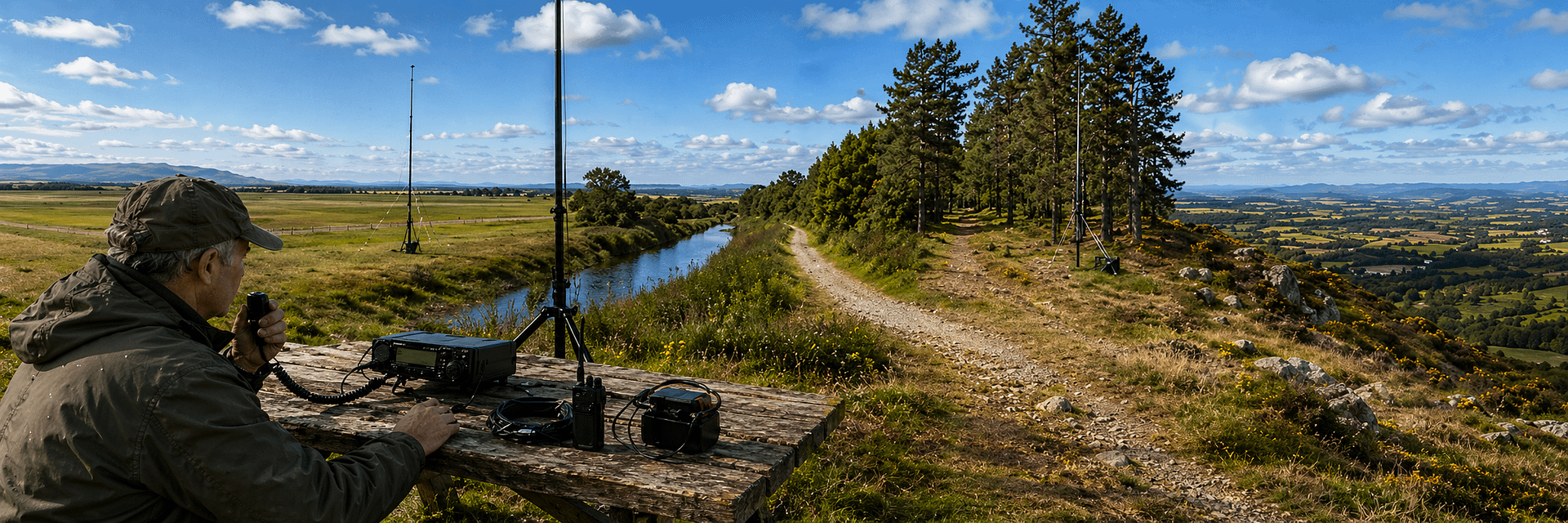
Portable radio is one of the most enjoyable parts of amateur radio. It gets you out of the shack, away from household electrical noise, and into locations where antennas often work better. For beginners, it is also a practical way to learn how radios, antennas, batteries and propagation behave in the real world.
County Kildare is a great place for portable operating because it has open plains, forest parks, bogland, canals, heritage towns, community spaces and accessible walking areas. Not every scenic location is suitable for radio, and not every good radio location is suitable for public access, so the best sites are those that balance radio performance, safety, access and respect for other users.
Before operating anywhere, always check access rules, avoid private land unless you have permission, keep antennas away from power lines and paths, and leave no trace.
What Makes a Good Portable Radio Location?
A good portable radio location usually has a few important features.
For VHF and UHF, height and clear lines of sight are very useful. Even a modest handheld radio can perform much better from a raised location than from inside a house.
For HF, space can matter more than height. A quiet field edge, park area or open space where you can safely deploy a wire antenna may work very well.
For all types of portable operation, look for:
Easy and legal access.
Safe parking nearby.
Enough space for a small antenna.
Low electrical noise.
No overhead power lines.
Limited risk of causing obstruction.
Shelter or a quick escape route if the weather changes.
Respect for walkers, wildlife and local users.
1. The Curragh Plains
The Curragh is one of the most distinctive landscapes in Kildare. Its wide open grassland makes it visually and practically attractive for portable radio. IntoKildare describes the Curragh Plains as a large area of semi-natural grassland, and it is one of the county’s most recognisable open landscapes.
For radio, the appeal is the openness. There are fewer buildings than in many urban locations, which may reduce local electrical noise. It can be a good place to test a handheld, a portable VHF/UHF antenna, or a simple HF receive setup.
The key issue is responsibility. The Curragh is an active and sensitive shared landscape. Do not block tracks, interfere with livestock, training activity, walkers or local users. Keep antenna setups compact, temporary and clearly visible.
Best for: simple VHF/UHF tests, listening, short portable sessions, photography and radio demonstrations.
Avoid: long wire antennas across paths, operating near livestock, or setting up where vehicles, walkers or horses may pass.
2. Hill of Allen
The Hill of Allen is one of the most obvious locations to consider from a radio point of view because elevation helps, especially for VHF and UHF. AllTrails describes the Hill of Allen as standing above the flatter plains of Kildare, with a short but steep walk and views from the top.
For portable operators, a raised site can make a significant difference. A handheld radio with a better antenna, or a small portable VHF station, may hear more activity than it would from a low-lying location.
However, hilltop operation needs care. Keep equipment light, watch the weather, avoid operating in exposed conditions, and never set up antennas if there is any risk of lightning. Use compact antennas and avoid creating trip hazards.
Best for: VHF/UHF simplex, repeater access tests, lightweight portable operation.
Avoid: heavy equipment, large masts, poor weather, and any setup that affects other visitors.
3. Donadea Forest Park
Donadea Forest Park is one of Kildare’s most attractive outdoor locations. Discover Ireland notes that the park is a National Heritage Area covering 243 hectares of mixed woodland in northwest County Kildare, with walks, historic buildings and gardens. Coillte also highlights Donadea Castle and the estate’s historical features.
From a radio perspective, Donadea is better suited to relaxed portable listening, compact VHF/UHF operation, club walks or beginner demonstrations than large antenna experiments. Woodland can reduce some signals, but it also provides a pleasant and sheltered environment for learning.
There is a car park charge, and IntoKildare notes that the car park uses a cashless payment system, with toilets available during café opening hours.
Best for: beginner demonstrations, handheld radio practice, compact portable setups, club social outings.
Avoid: large masts, wires across paths, busy visitor areas and anything that interferes with walkers.
4. Mullaghreelan Wood
Mullaghreelan Wood near Castledermot is another good option for a quieter portable outing. Woodland locations are not always ideal for maximum signal range, but they can be excellent for learning how portable equipment behaves in real conditions.
A small handheld, roll-up antenna, compact vertical or receive-only setup can work well for a short session. The value of a location like this is not just radio performance; it is the chance to practise packing light, setting up safely and operating politely in a public amenity.
Best for: short portable sessions, handheld use, listening, low-impact club activities.
Avoid: obstructing paths, running wires through trees where people may walk, or setting up during very busy periods.
5. Bog of Allen Nature Centre and Lodge Bog Area
The Bog of Allen is one of the major landscape features of Kildare and the wider Midlands. Kildare County Council’s outdoor recreation material notes that remnants of the Bog of Allen include areas open to public access such as Lullymore Discovery Park and the Bog of Allen Nature Centre. Discover Ireland describes the Bog of Allen Nature Centre in Rathangan as being run by the Irish Peatland Conservation Council, focused on conserving representative Irish peatlands.
For amateur radio, bogland can offer open horizons and lower building density, which may help reception. It is also a strong location for linking radio with environmental education and local heritage.
This is a place where sensitivity matters. Stay on permitted paths, respect conservation rules, and avoid any antenna setup that could damage habitats.
Best for: listening, environmental-themed club outings, compact temporary stations, educational demonstrations.
Avoid: leaving paths, inserting supports into sensitive ground, or disturbing protected habitats.
6. Grand Canal and Royal Canal Areas
Kildare has excellent canal-side locations, and canals can be pleasant places for compact portable operation. Kildare County Council identifies the Grand and Royal canals among the county’s important open-space and recreational amenities.
Canal locations are best for lightweight, low-impact radio. A handheld, small vertical, compact mag-mount setup or receive-only radio can be ideal. They are also good for combining a radio session with a walk or cycle.
Because towpaths are shared spaces, avoid wires across paths and keep all gear close to you. Do not obstruct walkers, cyclists, anglers or boats.
Best for: handheld operation, receiving, short portable sessions, radio walks.
Avoid: long wire antennas, trip hazards, blocking towpaths or operating too close to other users.
7. Kildare Town Heritage Area
Kildare Town is a strong option for a heritage-themed portable radio activity. Kildare County Council provides audio guides for historic locations, and Kildare Heritage highlights Kildare Town’s walking tour as one of the county’s heritage audio guide routes. Discover Ireland also describes Kildare Town Heritage Centre as a visitor attraction in a restored 18th-century market house.
This would not be the place for large antennas or technical experiments, but it could be excellent for a special event theme, a club awareness day, or a compact demonstration if permissions are arranged.
Best for: club promotion, heritage-linked radio activity, special event themes, compact public demonstrations.
Avoid: setting up without permission, blocking public spaces, or using large masts in busy areas.
8. Local Parks and Open Spaces
Kildare County Council states that it owns and manages 19 parks in the county, ranging from 0.5 hectares to 16 hectares, with amenities including walks, playing pitches, playgrounds, outdoor gyms, seating and picnic benches.
These parks may be ideal for very simple radio activity, particularly for beginners. A picnic table, handheld radio, notebook and small antenna can be enough for a useful learning session.
However, public parks are shared spaces. Keep the setup small, safe and unobtrusive. For a larger club demonstration, seek permission in advance.
Best for: beginner training, handheld practice, short demonstrations, radio-and-coffee sessions.
Avoid: large antennas near playgrounds, guy ropes across grass areas, or operating during crowded times.
9. Community Halls, GAA Clubs and Car Parks by Permission
Some of the best portable radio locations are not scenic viewpoints at all. They are practical community locations with permission, parking, shelter and facilities. A GAA club, community hall, school grounds or local event space may be ideal for a club field day.
These sites can be excellent for beginners because they offer easier access, toilets, seating and sometimes indoor backup if the weather changes. They are also safer for demonstrations because you can control the layout and keep antennas away from the public.
Best for: field days, club training, public demonstrations, special event stations.
Avoid: assuming access; always get permission and agree where antennas, vehicles and cables will go.
10. Your Own Garden or Driveway
Do not overlook the simplest portable radio location: your own garden. A garden setup is perfect for beginners because you can test equipment without the pressure of being in a public place.
You can try:
A handheld with a better antenna.
A roll-up J-pole.
A mag-mount on a metal surface.
A temporary HF wire.
A small portable mast.
Battery power.
Logging contacts.
A garden session helps you learn what works before you bring equipment to a public site.
Best for: first experiments, antenna testing, learning radio controls, battery tests.
Avoid: annoying neighbours, unsafe wire placement, or transmitting before checking SWR and licence conditions.
Suggested Portable Setups
For a beginner VHF/UHF session, bring a handheld radio, spare battery, better antenna, notebook and local repeater information.
For a more capable portable setup, add a small mobile radio, battery pack, compact vertical antenna, coax, headphones and a simple logbook.
For HF portable, keep it simple: a small HF radio, battery, wire antenna, lightweight mast or throw line, tuner if needed, logbook and weather protection.
Safety and Good Practice
Every portable radio outing should follow a few simple rules.
Check the weather before you go.
Avoid overhead power lines completely.
Keep cables and guy ropes visible.
Do not obstruct paths or entrances.
Use headphones where appropriate.
Keep transmissions courteous and brief in public areas.
Respect wildlife, livestock and local users.
Bring everything home with you.
If operating as a club, appoint someone to look after safety and public interaction.
Final Thoughts
Kildare offers a wide range of portable radio possibilities. The Curragh gives open space. The Hill of Allen offers height. Donadea and Mullaghreelan provide woodland settings. The Bog of Allen links radio with landscape and conservation. The canals offer relaxed radio walks. Local parks and community spaces make beginner training easier.
The best location depends on your goal. For VHF, look for height. For HF, look for safe space. For beginners, look for comfort, access and support. For club events, look for permission, facilities and safety.
Portable radio does not need to be complicated. A radio, antenna, battery and notebook can turn an ordinary afternoon in Kildare into a practical and enjoyable radio experience.